Organizational Agility: Changing Direction Without Losing Control
Growth creates pressure. A company may need to respond to a new market, a change in customer demand, a leadership transition, rising costs, new technology, or an unexpected business challenge. The problem is that changing direction can create a different set of problems inside the organization.
Decisions slow down. Teams work from different priorities. Leaders become pulled into daily issues. Projects compete for the same resources. Employees are unsure who has authority to make decisions.
This is where organizational agility matters.
An agile organization is not simply one that changes quickly. It is one that can respond to change without losing accountability, operational control, or focus on business goals.
For founders and leadership teams, the challenge is rarely recognizing that change is needed. The harder challenge is making the change without creating confusion across the business.
Masterly Consulting Group helps leadership teams address that challenge through tailored consulting, strategic planning, operational improvement, executive guidance, and implementation support.
When Growth Makes Agile Organizations Harder to Change
A business can operate well for years with informal processes and direct communication. Then growth changes the equation.
More employees create more layers. More customers create more operational demands and changing customer expectations. New markets create new decisions and emerging opportunities. New technology changes how teams work, what skills are needed, and how much capacity the business has to deliver.
Eventually, the systems that supported the company at an earlier stage may no longer support the business today. This is often where traditional organizations start to feel strain as the pace of change increases across the entire company.
You may notice signs such as:
- Important decisions taking too long
- Different departments working toward competing priorities
- Leaders becoming involved in decisions that should happen lower in the organization
- Teams duplicating work or stepping on each other's responsibilities
- New initiatives taking longer to launch
- Employees waiting for approvals before moving forward
- Processes becoming harder to manage as the company grows
- Leaders struggling to respond to market changes without disrupting operations
These problems are not always caused by poor leadership. Often, the organization has simply outgrown the way it operates.
That is an organizational adaptability problem.
The business needs enough structure to maintain control, but enough flexibility to respond quickly when circumstances change without losing control. An agile organization is not simply one that changes quickly. It also builds a more efficient operation, helps people develop new skills, and supports the business in pursuing change in a way that stays accountable and contributes to long-term success.
Organizational Agility Without Organizational Chaos
Some leadership teams hesitate to make changes because they have seen what happens when change is poorly managed.
A new structure is announced, but employees do not understand their responsibilities. A new process is introduced, but teams continue using the old one. A major initiative is launched, but nobody knows who owns the final decision.
Moving faster does not solve these problems.
Effective organizational agility requires clarity around people, processes, priorities, decision-making, and accountability. That kind of clarity depends on an agile mindset, not just new workflows. It also requires an agile culture supported by agile values, where the right mindset helps teams adapt without losing direction. In practice, agile organizations build this through continuous improvement, a real cultural shift, and an agile transformation that reaches leadership, teams, and daily operations.
Masterly Consulting Group approaches business challenges by developing customized strategies based on the organization's needs, industry, goals, and size. Its consulting work includes strategic planning, process optimization, efficiency improvement, risk management, market expansion, and digital transformation.
The goal is not to create change for the sake of change. The goal is to help the organization operate more effectively while remaining capable of responding to what comes next.
Why Business Agility Matters When the Stakes Are High
For a growing company, slow adaptation can become expensive.
Some leadership teams hesitate to treat change as an agile transformation, but isolated process updates rarely fix the deeper issues. A delayed decision can postpone a product launch. An unclear reporting structure can create employee frustration. Poor coordination can affect customer service. A lack of accountability can allow important projects to stall.
Over time, these issues can affect more than internal operations. They can affect how customers, employees, partners, and investors view the organization.
Your brand is shaped by what the business consistently delivers.
If customers experience delays, inconsistent service, or repeated communication problems, they do not see the internal reasons behind them. They simply experience the result, which can reduce customer satisfaction and make it harder to respond to changing customer needs. Stronger feedback loops help teams adjust earlier, protect customer value, and support better value creation.
The same is true for employees. When priorities constantly change without clear direction, people can lose confidence in leadership and become less engaged, which can weaken employee engagement and make innovation harder to sustain.
Organizational agility helps leadership teams build an organization that can respond to change while maintaining a dependable operating environment. Effective organizational agility requires clarity around people, processes, priorities, decision-making, accountability, and an agile mindset. At the same time, sustained results usually require an agile culture and a broader cultural shift built on continuous improvement, active feedback, and a sharper focus on customer needs; companies with successful agile transformations are nearly 3x more likely to be top performers.
The Real Problem May Be the Operating Model
When an organization struggles to adapt, leadership teams sometimes look first for a new technology, a new hire, or a new process.
Those solutions may help, but the deeper issue can be the way the organization is designed.
Consider a company where:
- Decision rights are unclear
- Responsibilities overlap between departments, including human resources
- Leaders have too many approvals
- Teams lack shared performance measures at the team level
- Processes depend on individual employees rather than documented expertise
- Strategic priorities are not connected to daily work or value streams
- Knowledge sharing is limited across functions
- Self-organization is discouraged by the structure
Adding another system may not solve the underlying problem.
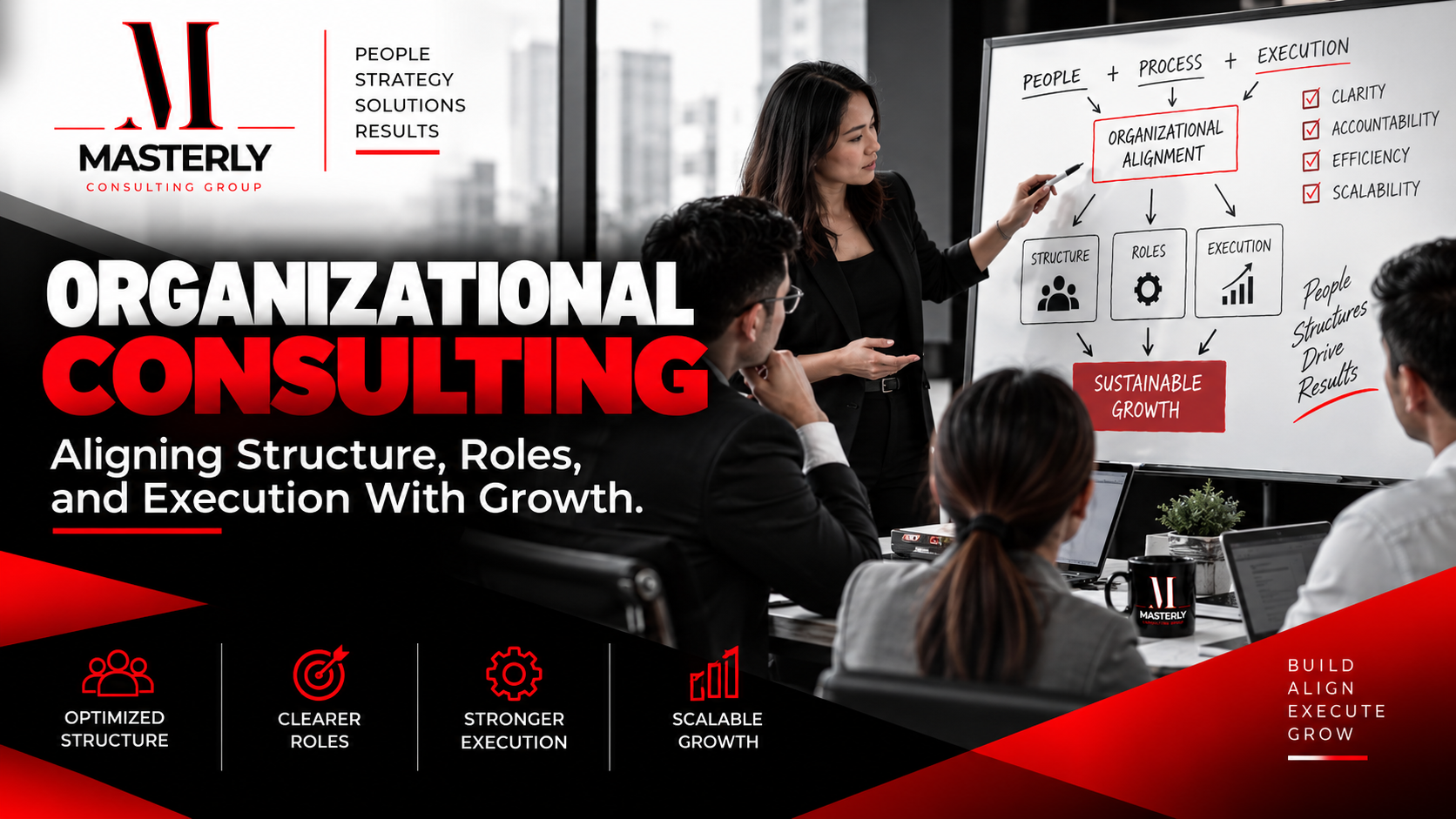
The organization may need a clearer operating model.
Masterly Consulting Group works with businesses to identify areas for improvement and develop practical strategies tailored to their challenges. Its approach includes strategic planning, implementation support, and ongoing evaluation.
That matters because organizational adaptability is not created by a single initiative. It is supported by the way the business is structured and managed.
What Strong Organizational Agility and Continuous Improvement Look Like
A more agile organization does not mean that everyone makes decisions independently.
It means the right people can make the right decisions at the right level.
Leadership maintains visibility over important priorities while agile teams have enough clarity and authority to move their work forward.
In practice, that can mean:
Clear priorities: Teams understand what matters most and how their work supports business goals with a shared sense of purpose.
Defined accountability: People know who owns important decisions and outcomes.
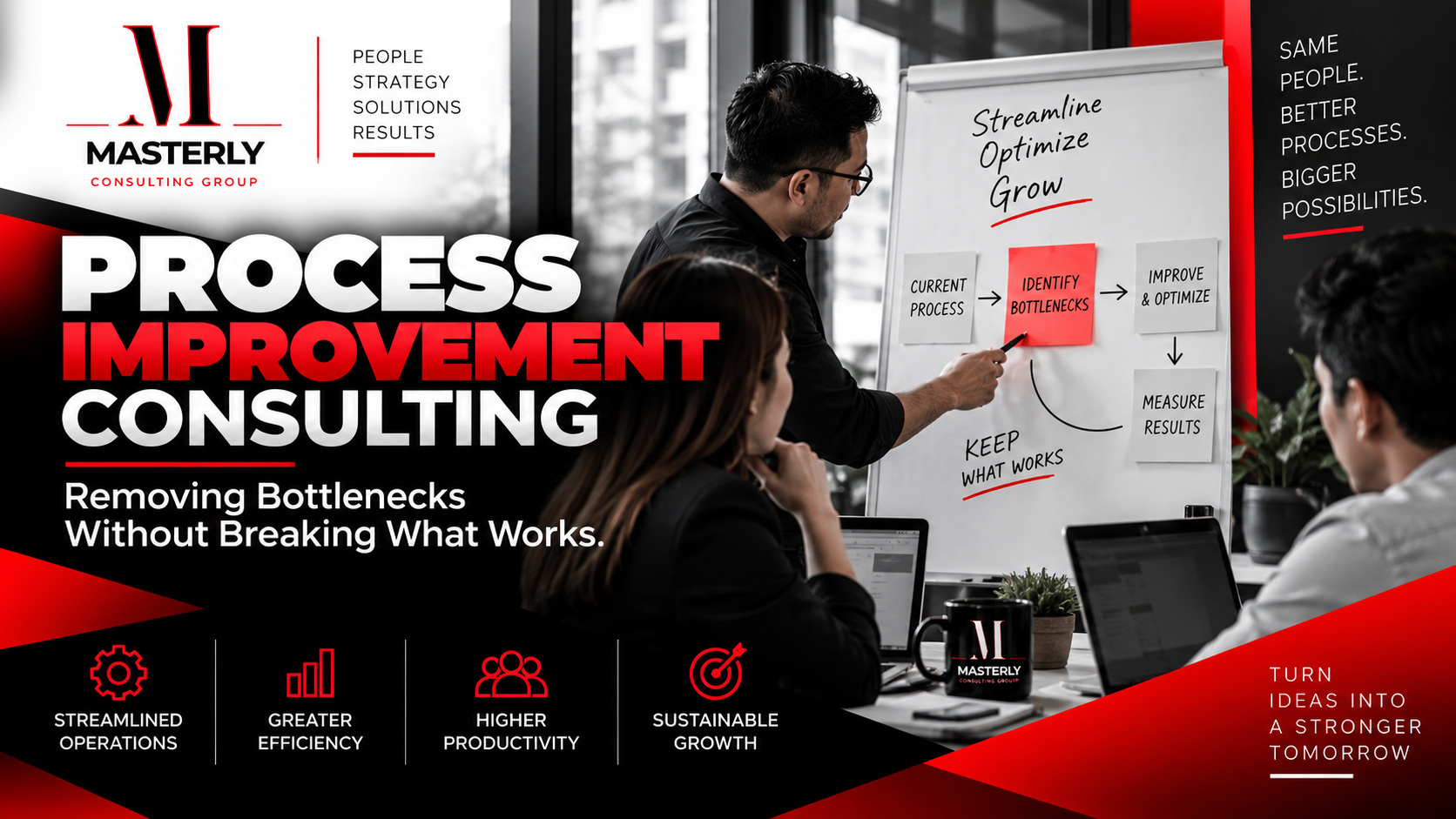
Better processes: Work moves through the organization without unnecessary delays or duplication, and weak knowledge sharing across functions is reduced.
Faster decisions: Leaders are not required to approve every operational issue, which improves speed.
Aligned leadership: Executives have a shared view of where the business is going and what needs attention.
Adaptable operations: The company can respond to new conditions without constantly rebuilding its internal structure, often by using an agile approach.
This balance is important. Too little structure creates confusion. Too much structure creates friction.
The right structure gives leadership control while allowing the organization to move in the shortest possible time.
When Your Agile Leadership Team Needs Outside Support
Organizational change can be difficult to manage while running the business at the same time, and building stronger organizational agility does not happen overnight.
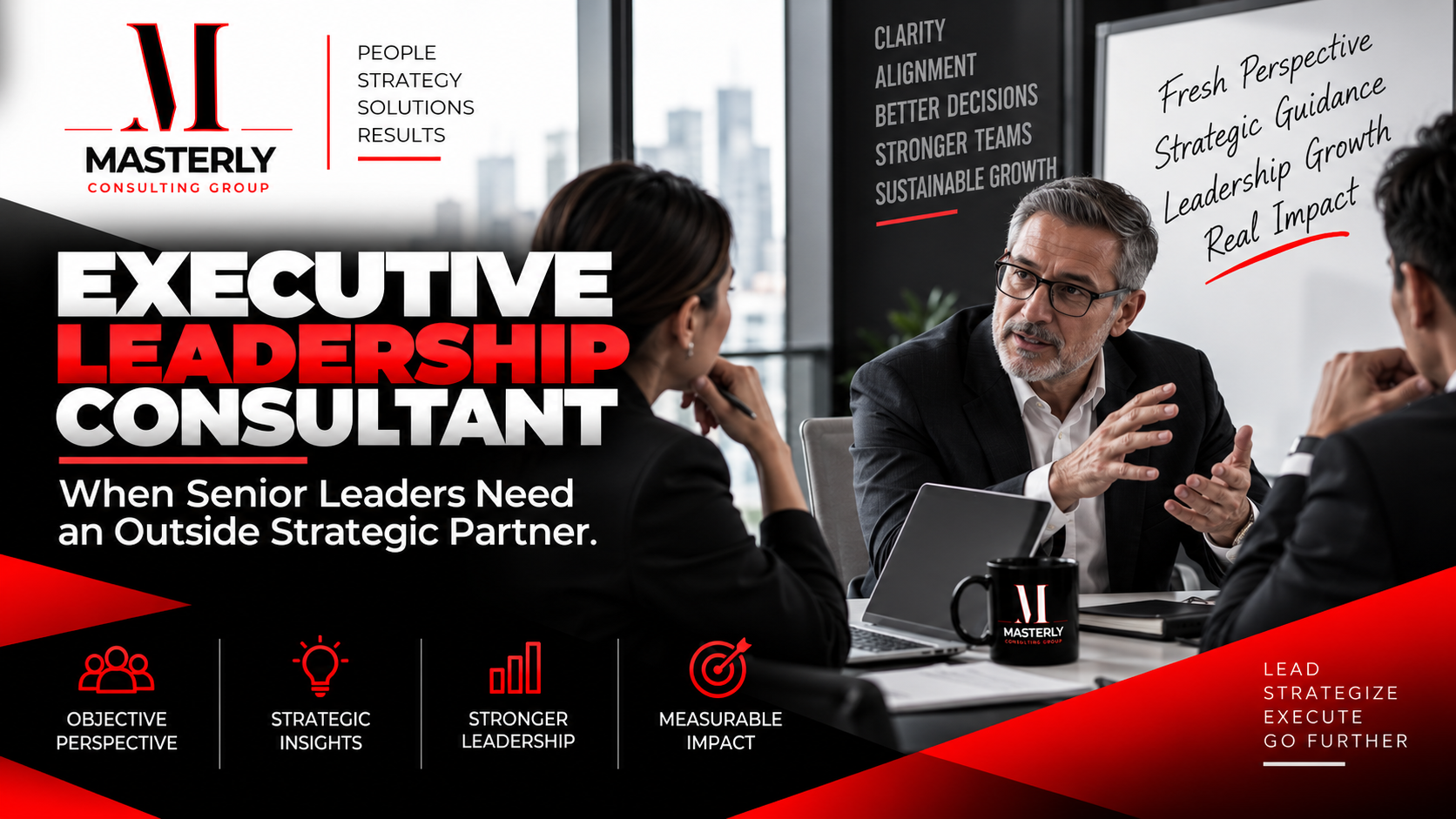
Founders and executives are often close to the problems they are trying to solve. Internal teams may also have strong opinions about what should change. That can make it difficult to step back and evaluate the organization objectively, even when most leaders can see that current ways of working are slowing execution.
Outside consulting can provide an independent perspective.
Masterly Consulting Group works with entrepreneurs, business owners, and professional managers to identify areas for improvement and develop strategies aligned with their goals. The firm also provides implementation support rather than stopping at recommendations. That support often includes agile leadership practices so agile leaders can remove barriers, give empowered teams clearer ownership, and help work move forward with less friction.
This is particularly valuable when a company is:
- Scaling into a new stage of growth and needs customer-centricity to stay clear as complexity increases
- Restructuring teams or leadership responsibilities; for example, clarifying decision rights so teams can act faster
- Entering new markets
- Experiencing operational inefficiencies and needing work to move in the shortest possible time
- Managing major organizational change
- Implementing new technology with iterative and incremental delivery, supported by rapid learning cycles
- Facing recurring execution problems
- Trying to improve leadership and decision-making
The right engagement should address the actual business problem, not apply a generic framework.
How Masterly Consulting Group Helps Leadership Teams Move Forward
Masterly Consulting Group provides customized consulting and executive coaching for businesses and other organizations. Its process begins with understanding the client's challenges, followed by strategic planning, implementation support, and ongoing evaluation.
For leadership teams dealing with organizational agility challenges, that means the work can focus on the areas creating the most friction. Most leaders already recognize the need for change, but often need outside perspective to act on it effectively.
Depending on the situation, this may include:
- Assessing current operations and organizational challenges
- Clarifying strategic priorities
- Improving organizational structure across the entire company
- Strengthening decision-making with better data analytics
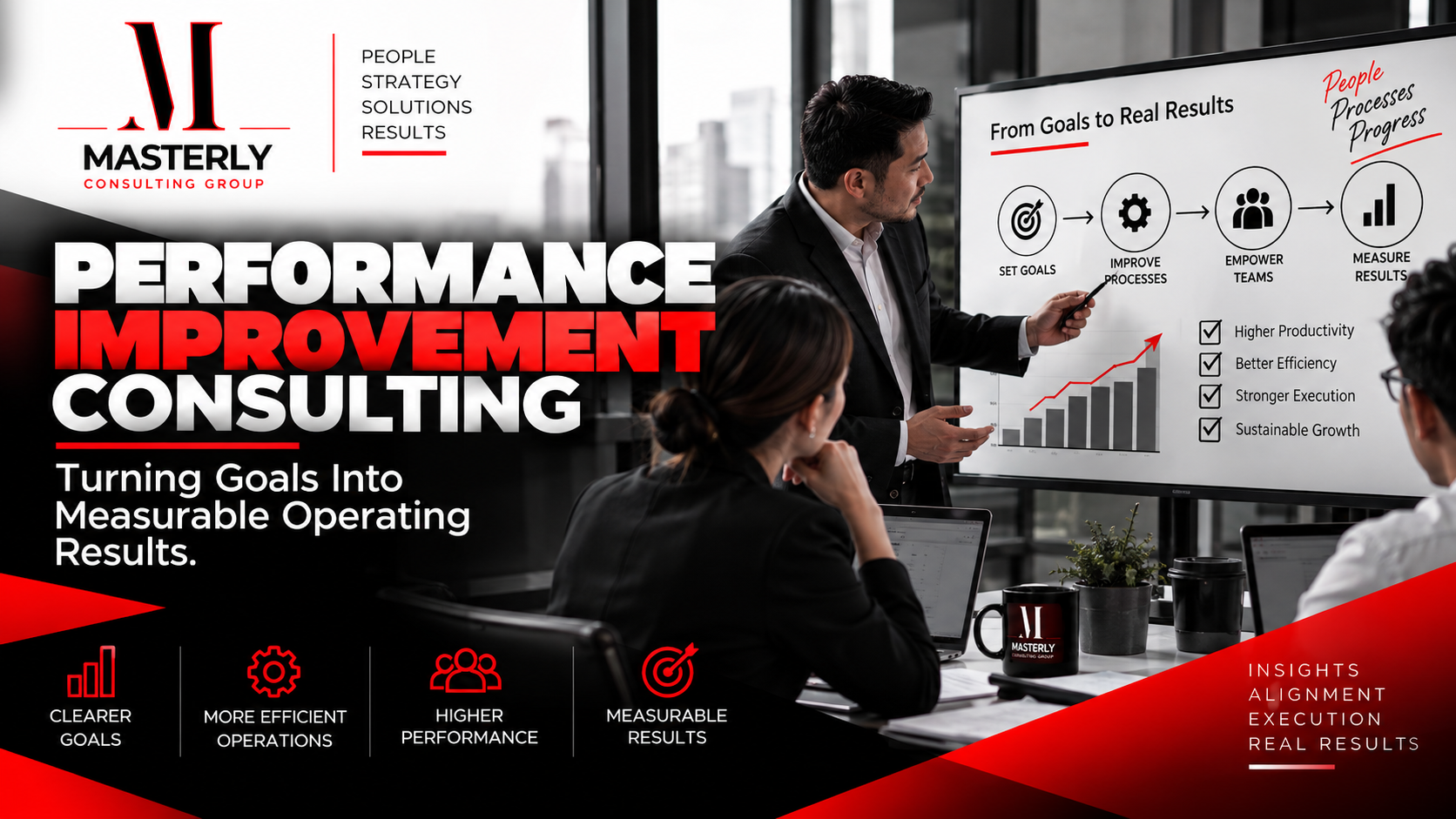
- Improving processes and workflows
- Aligning teams around business objectives
- Supporting technology and digital transformation, including solutions and services
- Improving leadership effectiveness
- Establishing clearer accountability
- Supporting implementation and follow-through
Masterly's broader transformation work also focuses on operating model design, governance, roadmap development, change management, and measurable adoption. Outside consulting can provide an independent perspective. Building agile leadership does not happen overnight. For example, support may address leadership behavior, execution, and the habits that help teams remove obstacles, deliver working software where relevant, and develop agile leaders who can lead change more effectively. In environments shaped by software development, that can also mean reinforcing agile principles such as tools working software over excessive process overhead. Companies with agile leadership see 30% increases in efficiency.
The result should be an organization that is better prepared to respond when the next significant change arrives.

Frequently Asked Questions About Organizational Agility
What is organizational agility?
Organizational agility is an organization's ability to respond to changing business conditions while maintaining clear priorities, accountability, and operational control.
Why does organizational agility matter for growing companies?
Growth increases complexity. Organizational agility is what makes an organization agile in practice, helping leadership teams respond to changing demands without allowing decisions, processes, and responsibilities to become unnecessarily complicated. It also supports continuous improvement, so teams can adapt while staying in control.
What is the difference between business agility and organizational agility?
Business agility focuses on how quickly a business can respond to market and customer changes. Organizational agility focuses more broadly on whether the company's people, structure, processes, and decision-making can support that response, sustain continuous improvement as complexity grows, and reflect agile values such as customer collaboration over comprehensive documentation, flexible contract negotiation, and contract negotiation responding to change. Companies that adopt agility often see about a 30% increase in efficiency.
Can organizational agility help a company that is already struggling with operations?
Yes. Organizational agility can be particularly valuable when slow decisions, unclear responsibilities, inefficient processes, or competing priorities are limiting business performance. It helps build the capacity to make faster decisions, allocate resources more effectively, and support innovation as teams adapt and improve. It is also shaped by agile values that emphasize customer collaboration and responding to change over rigid processes.
Does becoming an agile organization mean removing management structure?
No. A strong agile organization still needs structure. The objective is to create the right amount of structure so leaders maintain control while agile teams can make appropriate decisions, practice self organization, and increase operational capacity when teams are bottlenecked. Agile organizations can be five to ten times faster in productivity.
How can Masterly Consulting Group help with organizational agility?
Masterly Consulting Group provides customized consulting focused on business growth, operational improvement, strategic planning, implementation, leadership, organizational change, and agile transformation. The objective is to create the right amount of structure to support self-organization within clear guardrails, while building the expertise needed for organizational agility and ensuring agile teams still operate within defined accountability and management expectations.
Is organizational agility only for large companies?
No. Growing companies can benefit from improving organizational agility before complexity becomes a larger operational problem, and we support agile transformation where needed across the entire company. Masterly works with organizations ranging from growing businesses to established enterprises, with expertise in helping leadership teams build continuous learning into change so agility can last through growth. Sustainable agility also depends on a culture of continuous learning and psychological safety.
Request a Strategy Consultation
Your organization should be able to change direction without losing control, and improving agility can strengthen the entire company long before it becomes large or highly complex.
If growth, operational complexity, leadership challenges, or changing market conditions are making it harder to move with confidence, Masterly Consulting Group can help you evaluate the problem and develop a practical path forward so your team can respond quickly and act on new opportunities.
Masterly provides tailored consulting and implementation support designed around each client's specific needs rather than a one-size-fits-all approach.
Call (972) 236-5051 or visit Masterly Consulting Group to request a strategy consultation.
Build the organizational agility your business needs to adapt, execute, and grow with greater clarity.