Leadership Assessment What Organizations Should Measure Before Investing in Development
Why Leadership Assessment Matters Now
Organizations across industries are grappling with the same urgent problem: poor leadership decisions, widening leadership gaps, and no reliable way to objectively evaluate the people they put in charge. When leadership failures occur - missed targets, disengaged employees, costly turnover - the root cause is often that leaders were selected or promoted based on intuition, tenure, or credentials rather than evidence of actual leadership capabilities.
Leadership assessment is the systematic evaluation of leadership capabilities, potential, and effectiveness using structured, validated tools and methods. Unlike informal observation or gut-feel appraisals, a structured leadership assessment tool is data-driven, standardized, and designed to predict real-world leadership success. Leadership assessments use interviews and personality questionnaires, cognitive tests, 360-degree feedback, simulations, and more to build a clear picture of how an individual leads - and how they can grow.
The immediate impact of effective leadership assessment is measurable. Better hiring decisions reduce the risk of leadership misfires. Targeted leadership development focuses coaching and training on specific development areas rather than generic programs. A stronger leadership pipeline means organizations can identify emerging leaders early and prepare them for critical roles. Over 50 years of research supports leadership assessment effectiveness, and modern tools make it possible to assess leaders at every level - from first-time managers to C-suite executives.
When leadership assessments are done well, they help organizations understand strengths, gaps, and leadership impact more clearly while transforming how leaders are developed and how long term success is built. They identify strengths and development needs, surface actionable insights for improvement, and connect individual growth to the organization's mission. The result is measurable: stronger teams, improved retention, and leadership effectiveness that scales.
Proven Leadership Assessment Approach
The most impactful leadership assessment programs are grounded in evidence-based methodology refined through decades of industrial-organizational psychology research. Fortune 500 companies and leading healthcare systems alike rely on validated tools and scientifically rigorous processes to make leadership decisions with confidence.
What sets a proven approach apart is its combination of scientific rigor, comprehensive evaluation, and results orientation. Assessments measure talents and strengths against role requirements, ensuring that every data point connects back to what the organization actually needs from its leaders. Professionally developed assessment tools undergo extensive psychometric validation, including factor analyses, reliability metrics, and criterion-related validity studies that confirm they predict real outcomes like performance, retention, and engagement.
The proof is in the results. St. Luke's University Health Network implemented the CPI™ 434 leadership assessment in their final-stage hiring and onboarding process. Manager turnover dropped from 41% to 10%, the organization reported over $623,000 in annual savings, and the calculated ROI exceeded 3,100% within two years. This kind of measurable business outcome - not vague promises of "better leadership" - is what distinguishes a results-focused assessment approach.
Effective leadership assessments improve employee engagement and performance, reduce costly leadership failures, and create a direct link between assessment data and business strategy. When organizations commit to this approach, they gain the ability to predict candidate success in leadership roles and build a leadership team capable of navigating complexity.
What Makes Effective Leadership Assessment
Not all leadership assessments deliver value. The difference between a useful assessment and a wasted investment comes down to a handful of core principles.
Validity and reliability are non-negotiable. Validity means the assessment tool accurately measures the key leadership competencies it claims to measure. Reliability means results are consistent across time, raters, and methods. Research into leadership scales used in healthcare found that while roughly 88% of tools had acceptable internal consistency (Cronbach's alpha above .70), far fewer met standards for test-retest reliability, discriminant validity, or cross-cultural adaptation. Ensure assessment tools are statistically valid for hiring decisions - poorly validated instruments waste resources and misidentify leadership potential.
Job-relevance and role specificity are equally critical. Identify core competencies before selecting assessment methods, because the importance of matching methods to the purpose of the assessment comes first. The competencies assessed must align with what leadership success actually looks like in a given role, organization, and strategic context. Generic leadership models risk producing feedback that feels irrelevant to the real challenges leaders face.
Multi-dimensional evaluation covers the full range of what matters: leadership skills, key leadership competencies, behaviors, cognitive abilities, emotional intelligence, decision making, and soft skills like adaptability and communication. Early leadership research produced companion scales measuring aspects such as coaching, incisiveness, and future orientation - offering a rich behavioral breakdown that goes far beyond surface-level traits.
360-degree feedback incorporating multiple perspectives from peers, direct reports, supervisors, and clients provides a holistic view of leadership effectiveness. This also gives organizations a strong sense of how a leader is experienced by others. 360-degree assessments gather feedback from multiple perspectives, uncovering blind spots and revealing how a leader's self-perception aligns with the perceptions of those they work with. However, recent research warns that vague feedback terms like "presence" undermine the usefulness of 360 assessments, especially in hybrid or remote environments where face-to-face cues are limited. Items must be specific and behaviorally anchored to produce feedback that is truly actionable.
Alignment with organizational goals ensures the assessment connects individual capabilities to the company's strategic priorities, values, and culture. When leadership assessment reflects the organization's mission, it produces insights that drive both personal professional growth and enterprise-level results.
Cultural sensitivity matters more than ever in global organizations. A 2026 review of over 400 studies found that almost none of the instruments imported across cultures fully adhered to recommended strategies for cultural adaptation. Assessments that ignore cultural differences risk bias, misinterpretation, and unfair outcomes for leaders operating in diverse contexts.
Types of Leadership Assessment Tools
Different assessment methods serve different purposes. The best leadership assessment tools combine multiple approaches - because no single tool captures the complete picture of leadership potential. Choose tools based on specific assessment goals, whether that is selection, development, succession planning, or team composition. Use multiple assessment methods for comprehensive evaluation.
360-Degree Feedback Assessments
360 leadership assessments provide feedback from multiple perspectives - supervisors, peers, direct reports, and sometimes clients or external stakeholders. They are multi-rater evaluations designed to surface a comprehensive view of leadership effectiveness and behavioral impact.
360-degree feedback assessments provide comprehensive performance insights. They are especially valuable for development purposes and identifying blind spots - the gaps between how a leader sees themselves and how others experience their leadership style. The VAL-ED assessment used across more than 270 schools demonstrated reliable subscale distinctions among principal leadership dimensions, proving that well-designed 360 tools can differentiate meaningful aspects of leadership performance.
360-degree feedback improves leadership development and organizational alignment. The key limitation is that effectiveness depends on clarity of items, rater training, and cultural fit. Without these, rating fatigue and bias can undermine results. Consider user experience to encourage honest responses.
Personality and Behavioral Assessments
These tools measure personality traits, behavioral preferences, and leadership style. They assess emotional intelligence, communication style, and decision-making approach, providing a stable baseline for coaching and self awareness development.
Behavioral assessments predict real-world performance under normal and high-pressure situations. Common tools include DISC, Myers-Briggs, Big Five personality models, and emotional intelligence measures. Korn Ferry's assessments evaluate leadership styles and emotional intelligence, while The Leadership Circle assesses behavioral styles and competencies. Leadership assessment tools can include personality questionnaires and simulations, making them versatile for team composition, coaching, and identifying key traits.
The caveat: personality tools vary widely in scientific validation. The Big Five model is well-supported by research; others, like DISC, have less rigorous empirical backing. Effectiveness depends on connecting personality data to specific role requirements rather than treating traits as universally predictive.
Cognitive Ability, Learning Agility, and Skills Assessments
Cognitive ability and learning agility tests assess reasoning and adaptability. Ability tests measure verbal, numerical, and abstract reasoning skills - the mental capabilities that underpin strategic thinking, complex problem-solving, and sound decision making under uncertainty.
These assessments predict performance in roles that demand analytical capabilities and learning agility. They are particularly useful for identifying leaders who can manage ambiguity, synthesize information, and adapt their approach as circumstances change. The limitation is that cognitive tests may neglect emotional and social competencies, and ceiling effects can make it difficult to differentiate among high-performing candidates.
Simulation and Situational Assessments
Business simulations, role-plays, in-basket exercises, and case study exercises place leaders in realistic scenarios that mirror actual leadership challenges. Situational judgment tests present job-relevant scenarios for evaluation, requiring participants to judge the importance of the information in front of them before responding, while allowing assessors to observe leadership behaviors under pressure and in team settings.
These tools are especially powerful for senior leadership roles where the context of decision making matters as much as the decision itself. They allow assessment of soft skills, adaptability, strategic thinking, and group dynamics in ways that questionnaires cannot replicate. Modern assessment center methodology traces its origins to military selection processes and has evolved into one of the most comprehensive - and resource-intensive - approaches available.
The tradeoff is cost, logistical complexity, and the challenge of scaling these methods, especially for remote or hybrid organizations. Evaluator training is essential to control bias.
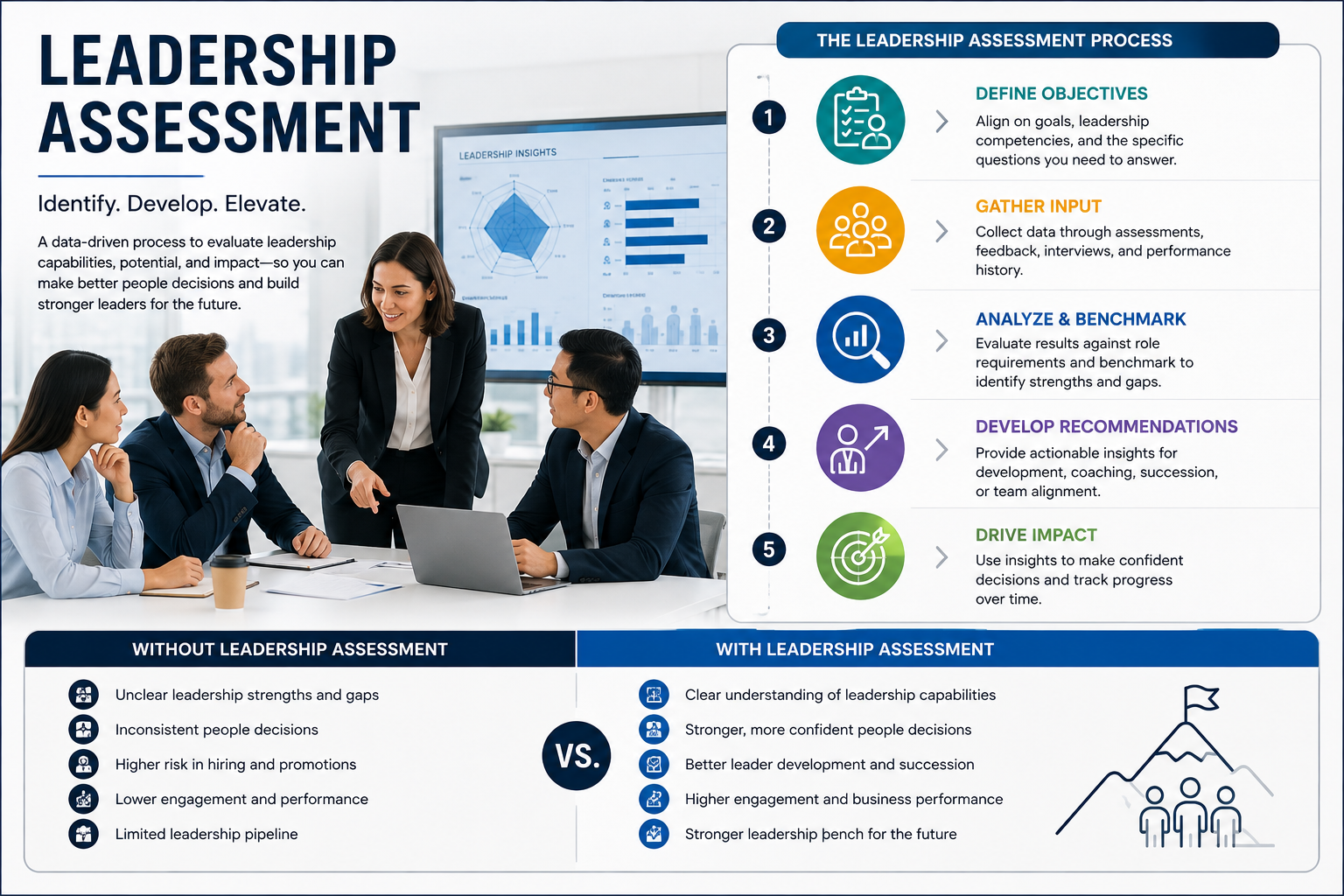
Leadership Assessment Process
A systematic approach ensures accurate, fair, and actionable results. Assessments are often most effective when used as part of ongoing development journeys, not one-time events.
Step 1: Define Leadership Requirements
Every effective assessment begins with clarity about what leadership success looks like. This means conducting job analysis and competency modeling for specific leadership roles: mapping the critical competencies, behaviors, and outcomes that matter for a given position and organizational context.
Align assessment criteria with organizational strategy and culture. Review strategic direction, stakeholder expectations, and the leadership competencies that drive results in your company. Without this step, tools measure the wrong things - and development efforts miss the mark.
Step 2: Select Assessment Methods
Choose the right leadership assessment tool, or mix of tools, based on role level and assessment purpose. A first-time manager assessment might emphasize evaluating leadership skills such as coaching behaviors and team management at that level; a C-suite evaluation may focus on strategic thinking, stakeholder management, and global leadership.
Combine multiple methods for comprehensive evaluation - for example, 360 feedback paired with cognitive assessment and a situational simulation. Research consistently shows that multi-method assessment increases validity and reduces the risk of bias. Consider practical factors: time, cost, candidate experience, remote adaptability, and data privacy.
Step 3: Conduct Assessment and Analysis
Professional administration ensures consistency and fairness. Standardize procedures, train raters to reduce common biases (leniency, halo effects, social desirability), and ensure data collection is rigorous.
Data analysis and interpretation by qualified assessors - ideally industrial-organizational psychologists or certified professionals - integrates quantitative scores, factor analysis, and inter-rater reliability across methods. The goal is to build a coherent leadership profile from multiple data sources, not just report disconnected scores.
Step 4: Feedback and Development Planning
Detailed feedback reports help leaders understand their strengths and development areas with greater specificity. Effective assessments provide actionable insights for leadership improvement - not vague summaries, but behaviorally anchored observations linked to clear development recommendations.
Actionable development recommendations might include targeted coaching, stretch assignments, mentoring, or training programs. For senior leaders, enhanced 360 feedback models that include co-created development plans, measurable goals, and board or HR involvement have shown more sustainable behavior change.
Follow-up assessment to track progress and improvement completes the loop. Without longitudinal tracking, organizations cannot quantify whether assessment-driven development actually changed leadership behaviors or business outcomes.
Leadership Assessment Results and Impact
The business case for leadership assessment is backed by hard data. Leadership assessments enhance self-awareness and effectiveness for leaders, and the organizational benefits compound over time.
Concrete outcomes include improved promotion success rates, reduced leadership failures, and enhanced team performance. Effective leadership correlates with team morale and retention rates - when leaders improve, their teams perform better, stay longer, and engage more deeply.
ROI statistics make the case clearly. St. Luke's University Health Network saw manager turnover drop from 41% to 10% after implementing leadership assessment in hiring and onboarding, saving over $623,000 annually with a 3,100%+ ROI. High-quality assessments boost morale and productivity in organizations by ensuring the right people are in the right leadership roles - and that development resources are targeted where they create the greatest impact.
Long-term organizational benefits include a stronger leadership pipeline, improved succession planning, and enhanced organizational culture. When assessments are used consistently, they create a feedback-rich environment where leaders at every level are supported to reach their full potential.
Success Stories
Real results demonstrate how leadership assessment translates into measurable impact across organization types and leadership levels.
St. Luke's University Health Network faced a 41% manager turnover rate - a costly, destabilizing problem. By implementing the CPI 434 assessment as part of final-stage hiring and onboarding, they reduced turnover to 10%, retained 90% of managers, and saved over $623,000 annually. The ROI exceeded 3,100%, demonstrating that leadership assessment delivers returns far beyond its cost.
Performance Assessment for Leaders (PAL) was developed in Massachusetts for licensing school principals. Field trials confirmed the tool was both valid and reliable, and candidates viewed the experience positively. This example shows assessment serving both regulatory and developmental purposes - identifying principals who are prepared to lead and highlighting areas for continued growth.
These cases span healthcare, education, first-line management, and senior leadership - illustrating that well-designed assessment programs create quantifiable business metrics: retention, cost savings, and leadership effectiveness gains.
Leadership Assessment Applications
Leadership assessments enhance selection for critical roles and support development across the entire leadership lifecycle. Leadership assessments predict candidate success in leadership roles.
- Leadership Selection and Hiring: Use assessment tools to identify fit, potential, and readiness - reducing the risk of costly leadership mistakes and ensuring new hires can manage effectively from day one
- High-Potential Identification and Succession Planning: Assess emerging leaders for readiness, identify future ready leaders, and build robust succession pipelines
- Leadership Development Programs: Begin development initiatives with assessment to tailor coaching, training, and learning interventions to each leader's specific needs and key competencies
- Executive and C-Suite Assessment: Evaluate strategic thinking, stakeholder management, adaptability, and global leadership capabilities for senior leadership roles
- First-Time Manager Assessment: Support new managers through assessment that identifies critical competencies for the transition from individual contributor to people leader
- Leadership Transition and Onboarding: Accelerate effectiveness when leaders enter new roles by using assessment to guide early priorities and focus areas
- Organizational Restructuring and Change Management: Determine which leaders have the resilience, adaptability, and skills to lead through transformation
Leadership assessments can be conducted virtually using technology, making these applications accessible regardless of geographic distribution or work model.
Frequently Asked Questions
How accurate are leadership assessments?
Accuracy depends on the validity and reliability of the assessment tool and the qualifications of the administrator. Professionally developed tools frequently report high internal consistency and acceptable predictive validity. However, not all tools meet rigorous standards - research in healthcare leadership found that only about 20 out of 33 scales reviewed had good construct validity, and discriminant validity and cross-cultural validation were rare. The takeaway: use validated instruments administered by qualified professionals to gain accurate, trustworthy insights.
What's the difference between assessment for selection vs. development?
Selection assessments focus on prediction and comparison - how well does this candidate's profile predict success in a specific leadership role? They require benchmarking, fairness, and legal defensibility. Development assessments emphasize growth opportunities, coaching, and self awareness. They focus on identifying strengths, weaknesses, and development areas to support professional growth over time. Both are valuable; the purpose determines which methods and standards apply.
How long does a leadership assessment take?
It varies by method and depth. Personality questionnaires may take 15–30 minutes. 360-degree feedback processes with multiple raters may require several weeks to collect data, aggregate results, and deliver feedback. Assessment centers with simulations can span one or more full days. Factors affecting duration include role complexity, number of assessment methods used, scheduling logistics, and whether follow-up assessment is included.
Can assessments be conducted remotely?
Yes. Many leadership assessment tools now have digital platforms supporting virtual 360 feedback, online simulations, and remote assessment centers. Key considerations include maintaining validity of behavioral observation (some behaviors are harder to assess remotely), designing situational tasks that work virtually, managing technology access, ensuring confidentiality, and coordinating raters across time zones. A 2026 study comparing AI and human experts in analyzing 360 feedback found that hybrid AI-human models offer efficiency gains while preserving interpretive nuance - a trend likely to expand remote assessment capabilities further.
Discuss a Leadership and Organizational Assessment With Masterly Consulting Group
Need a clearer view of leadership strengths, organizational priorities, team alignment, and areas that may be limiting performance? Discuss your leadership structure, organizational needs, decision-making processes, and growth priorities with Masterly Consulting Group. Call (972) 236-5051 to discuss a leadership and organizational assessment tailored to your organization.