Corporate Governance The Operating Discipline Growing Companies Need Before Decisions Get Harder
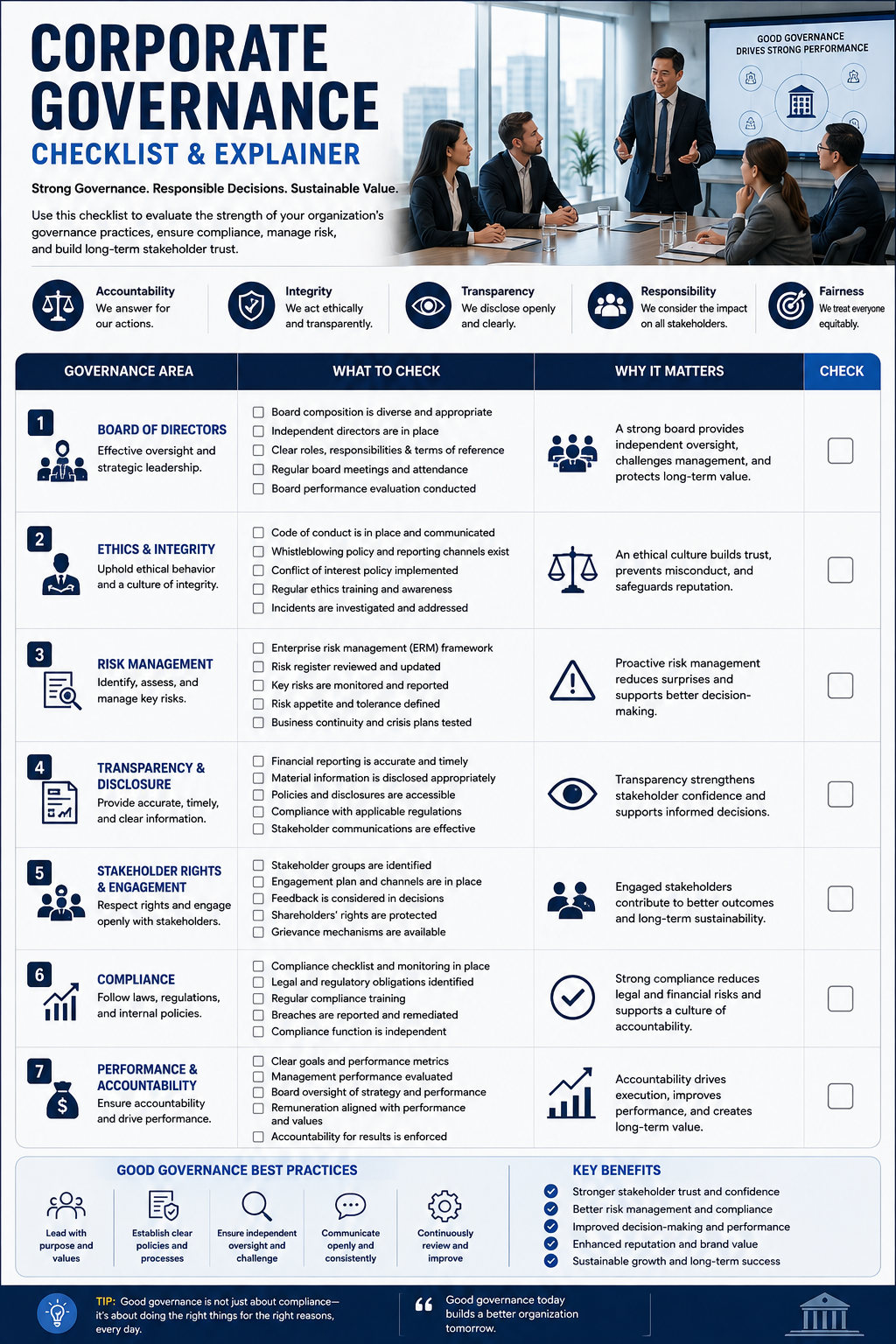
If your organization is struggling with unclear decision-making authority, compliance risks, or stakeholder trust issues, implementing strong corporate governance provides the framework for accountability, transparency, and sustainable growth. Corporate governance refers to the mechanisms, processes, and institutions through which companies are directed and controlled - and it's essential for public companies, private firms preparing for IPO, family businesses, nonprofits, and government agencies that need to protect stakeholder interests and support long term success.
Whether you run a publicly traded corporation or a growing family business, good governance creates clear rules, oversight, and controls that reduce legal and compliance risk, improve operational efficiency, strengthen investor and stakeholder confidence, and keep your organization on solid ground before decision-making becomes harder to untangle. This guide explains what corporate governance is, why it matters, the core principles behind it, the benefits of strong governance, how to implement it, the main governance models, and real world examples across the sectors served.
Why Organizations Trust Strong Corporate Governance
Corporate governance ensures legal and regulatory compliance, reducing the risk of costly legal battles. But its value runs far deeper than avoiding penalties. Robust oversight structures help prevent financial mismanagement and regulatory breaches, while building the foundation for sustained organizational performance.
- Reduces regulatory compliance risks - Strong corporate governance can prevent costly scandals and financial losses. Corporate governance frameworks have a significant impact on long-term corporate sustainability and market confidence.
- Builds investor confidence - Good corporate governance fosters investor confidence and enhances access to capital. A cross-country study of 6,663 firms found that a one-standard-deviation increase in a governance index corresponded to approximately 3.5–4.2% higher firm valuation.
- Provides clear decision-making frameworks - When the board determines strategy and senior management executes, conflicts and inefficiencies drop. Clear lines of responsibility aligned with performance-based executive compensation enhance operational efficiency.
- Protects against reputational damage - Effective governance frameworks help mitigate risks and protect futures. A company's reputation is one of its most valuable assets, and governance is the shield that preserves it.
Why Companies Choose Effective Governance Frameworks
What separates strong corporate governance from basic corporate compliance? It comes down to whether governance is treated as a strategic leadership function with a clear focus or merely a box-ticking exercise. Effective governance emphasizes transparency, ensures accountability at every level of the entire organization, and connects board oversight directly to business outcomes.
- Stakeholder trust as a competitive advantage - Good corporate governance builds stakeholder trust and enhances reputation. Engaging stakeholders builds trust and strengthens relationships, and companies with strong governance attract and retain committed customers. It balances the interests of a company's stakeholders including shareholders, management, customers, suppliers, financiers, and the community.
- Risk mitigation tied to real outcomes - Risk management frameworks help organizations identify, assess, and mitigate various risks. When risk management is embedded in governance rather than bolted on, organizations spot threats earlier and respond faster.
- Measurable financial performance gains - In Brazil's premium governance segment, firms adopting voluntary governance reforms earned abnormal returns of approximately 10.68% annually from 2001 to 2005. Good corporate governance fosters ethical business practices and stakeholder trust, which translates directly into shareholder value.
Core Corporate Governance Principles
Corporate governance principles guide decision-making and accountability in organizations. The core principles below form the fundamental pillars of any effective governance process - whether your company is a multinational or a local enterprise.
Accountability and Transparency
The core principles of corporate governance include accountability and transparency. Accountability requires the board of directors to be accountable to shareholders for corporate performance. This means clear reporting structures, performance measurement systems, and regular disclosure of material information to key stakeholders.
Transparency requires companies to provide timely, accurate information on financial and governance matters. Mechanisms that support this include audit committees staffed with independent directors, internal controls, whistleblower protections, and external auditing. Regular audits enhance financial reporting reliability. The board of directors approves key corporate compliance policies, and board oversight includes monitoring compliance with internal control policies.
The Sarbanes-Oxley Act of 2002 increased financial transparency requirements and improved corporate accountability standards - a direct response to governance failures that destroyed billions in shareholder value.
Fairness and Responsibility
The principles of corporate governance include fairness and responsibility. Fairness requires organizations to treat all shareholders equitably, including minority and foreign shareholders. This extends to proxy access, majority voting standards, and strict rules around related-party transactions.
Responsibility involves recognizing legal, moral, and environmental obligations to wider stakeholders. A diverse board enhances objective decision-making and oversight effectiveness. Independent board members are crucial for objective oversight and minimizing conflicts of interest. Establishing a code of conduct promotes ethical behavior across the organization, setting expectations from the boardroom to the front line.
Board composition ensuring independence and diverse expertise is not a luxury - it is a governance necessity. Directors are elected by shareholders to represent their interests, and they carry the leadership role of ensuring the company acts in the best interests of all parties.
Risk Management and Internal Controls
Risk management is a key principle of corporate governance. Systematic identification and mitigation of organizational risks - operational, financial, legal, reputational, and environmental - requires robust internal control systems and compliance monitoring.
Effective oversight involves enterprise risk management frameworks (such as COSO), regular audit processes, and corrective action protocols. The board sets the risk appetite, and executive management ensures the organization operates within those boundaries. Without these structures, risk accumulates undetected - as the Enron case demonstrated with devastating consequences.
How to Implement Corporate Governance
Implementing governance is a structured governance process that typically unfolds in three phases. Here is what to expect.
Step 1: Governance Assessment and Framework Design
Evaluate current governance gaps by mapping existing decision-making structures, internal controls, and regulatory requirements. Identify where your organization falls short of best practices or industry-specific rules - whether SEC regulations, stock exchange listing requirements, or local company law. Develop a board charter, define committee structures (audit, compensation, nominating/governance, risk), and benchmark against peers.
Step 2: Policy Development and Role Definition
Policy development is where governance becomes operational. Create or update the code of conduct, ethics policy, conflict of interest policy, whistleblower policy, and insider trading policy. Policy governance defines clear roles for boards and management. The board delegates authority to the managing director or CEO for day-to-day operations but retains strategic oversight. Define executive limitations - what management can and cannot do without board approval. Boards are responsible for hiring and evaluating the CEO, making this relationship definition critical.
The Carver Model, developed by John Carver, is one well-known policy governance model that separates governance from daily management tasks. Under this carver model, the board focuses on defining organizational Ends (what results the company should produce, for whom, and at what cost) and executive limitations, while allowing decision makers in management reasonable interpretation in execution. Policy governance emphasizes accountability through systematic monitoring.
Step 3: Implementation and Monitoring Systems
Deploy governance processes through training programs for the board and senior management on their responsibilities. Establish ongoing monitoring through board self-assessments, committee effectiveness reviews, and compliance tracking systems. Continuous improvement is essential - adjust policies as regulations evolve and stakeholder expectations shift.
Timeline: Basic framework implementation (charters, committees, code of conduct, defined roles) takes 6–12 months for most organizations. Full cultural integration and optimization requires 18–24 months.
Corporate Governance Models and Outcomes
Different governance models suit different contexts. Understanding them helps organizations choose the right structure for their industry, ownership profile, and strategic initiatives.
Anglo-American Shareholder Model
The Anglo-American Model prioritizes shareholder interests in governance. Dominant in the U.S., UK, and Australia, this board-centric approach focuses on shareholder value maximization. Key features include independent directors, separation of CEO and Chairman roles, strong investor protections, and rigorous disclosure requirements.
Results: Strong financial performance, high investor confidence, and efficient capital markets. However, this model can sometimes underweight employee welfare and environmental considerations, and executives may face pressure toward short-termism.
Continental Stakeholder Model
The Continental Model features a two-tiered board structure - a supervisory board and a management board - common in Germany, the Netherlands, and parts of Europe. This model places emphasis on employee, community, and environmental considerations, often including works councils and codetermination rights.
Outcomes: More sustainable growth, greater social legitimacy, and stakeholder satisfaction. The trade-off is potentially slower decision making and more complex regulatory compliance. The Japanese Model, while distinct, shares some stakeholder orientation but often excludes smaller shareholders from governance participation.
Hybrid and Emerging Models
Flexible approaches combining shareholder and stakeholder priorities are gaining momentum globally. ESG-integrated governance and purpose-driven frameworks represent the leading edge. According to an IFAC/AICPA/CIMA 2024 report, 76% of large global companies reported sustainability information integrated with financial disclosures, and 59% obtained assurance from audit firms on those disclosures.
These adaptable structures work across different industries and company sizes, though they introduce complexity in balancing financial and ESG priorities. Shareholder engagement allows investors to participate actively in key corporate decisions, and research from INSEAD shows that when shareholder governance proposals pass, firms see measurable stock market returns of approximately 2.8%.
Governance Success Stories and Cautionary Tales
Real examples demonstrate how governance directly shapes outcomes - for better and for worse.
PepsiCo: Excellence in Governance Implementation
PepsiCo provides a model of effective oversight in action. In its 2026 proxy statement, 38% of director nominees are female and 31% are racially or ethnically diverse. A diverse board enhances decision-making and oversight effectiveness, and PepsiCo demonstrates this principle through its board composition, independent committees, annual election of all directors, majority-vote policy, and proxy access provisions.
The company's governance guidelines include a Sustainability and Public Policy committee - strategic leadership that integrates ESG considerations at the board level. Transparent reporting and stakeholder engagement practices have contributed to sustained growth and an industry leadership reputation. Effective corporate governance enhances stakeholder trust and long-term value, and PepsiCo illustrates what that looks like in practice.
Enron: Governance Failure and Lessons
The Enron collapse of 2001–2002 remains the definitive cautionary tale. Enron's board approved complex off-balance-sheet entities controlled by the CFO that concealed massive liabilities. Disclosure policies were deliberately opaque, audit committee oversight was weak, and conflicts of interest were pervasive. Good corporate governance reduces bankruptcy likelihood for investors - but Enron's shareholders learned that lesson through catastrophic losses.
The lack of oversight, transparency issues, and board independence problems led to regulatory scrutiny, investor loss, and permanent reputational damage. Key lessons: governance structures must not merely exist on paper - they must provide direction and be connected to actual risk and operations. The "tone at the top" matters. Integrity in leadership is non-negotiable. These failures directly triggered the Sarbanes-Oxley Act of 2002, reshaping corporate accountability standards for an entire generation.
In the MENA region, Tuninvest demonstrated the opposite trajectory: by revising board composition (adding independent outsiders), formalizing board procedures, and creating an audit committee, revenue doubled over five years and valuation increased approximately 50%.
Industries and Organizations We Support
Corporate governance is why is corporate governance important across every sector. We work with organizations including:
- Public companies subject to SEC regulations and Sarbanes-Oxley requirements that must ensure regulatory compliance and deliver accurate information to investors
- Private companies preparing for IPO or seeking investor funding from private equity or venture capital firms
- Nonprofit organizations requiring board governance, ensuring accountability, and demonstrating responsible stewardship to moral owners and donors
- Family businesses transitioning to professional management structures - where expertise in separating ownership from authority is critical
- Government agencies and public sector organizations that must meet legal requirements and demonstrate integrity in operations
Strengthen Governance With Clear Policy Principles and Leadership Accountability
Strong governance depends on clear policy governance principles that define how decisions are made, who has authority, and how accountability is maintained. A capable leader needs more than authority alone. Leaders need clear expectations, decision boundaries, and a governance structure that supports consistent action across the organization. Masterly Consulting Group can help organizations review governance policies, leadership responsibilities, decision rights, and operating structures so they work together more effectively.
Frequently Asked Questions
What are the costs of implementing corporate governance?
Governance costs typically range from 0.5% to 2% of revenue depending on company size, complexity, and industry. The ROI includes risk reduction, improved valuations, and regulatory compliance benefits. In emerging markets, governance reforms have delivered abnormal returns exceeding 10% annually - far outweighing implementation costs.
How long does it take to establish effective governance?
Basic framework implementation - including charters, committees, code of conduct, and role definitions - takes 6–12 months for most organizations. Full cultural integration and optimization, where governance becomes embedded in how the business operates rather than layered on top, requires 18–24 months.
What board composition ensures effective governance?
A majority of independent directors with relevant industry and functional expertise is the foundation. Diverse backgrounds - financial, legal, operational, and strategic skills - strengthen the board's ability to provide effective oversight. The board must maintain clear separation between board oversight and management execution roles. PepsiCo's composition (38% female, 31% racially/ethnically diverse) provides a strong benchmark.
Why is corporate governance important for smaller organizations?
Many local and smaller firms face governance challenges such as unclear decision-making authority, conflicts of interest in family businesses, lack of formal reporting, and minimal transparency. Implementing governance practices scaled appropriately - having independent oversight, defining roles, documenting decision rights, conducting simple audits - improves credibility with lenders and investors while reducing fraud risk. Companies preparing for growth must adopt governance practices that signal readiness to lead at scale.
Discuss Governance and Operating-Structure Consulting With Masterly Consulting Group
Need clearer decision-making, defined accountability, and an operating structure that supports your organization’s goals? Discuss your governance model, leadership roles, decision rights, internal processes, and operating priorities with Masterly Consulting Group. Call (972) 236-5051 to discuss governance and operating-structure consulting tailored to your organization.