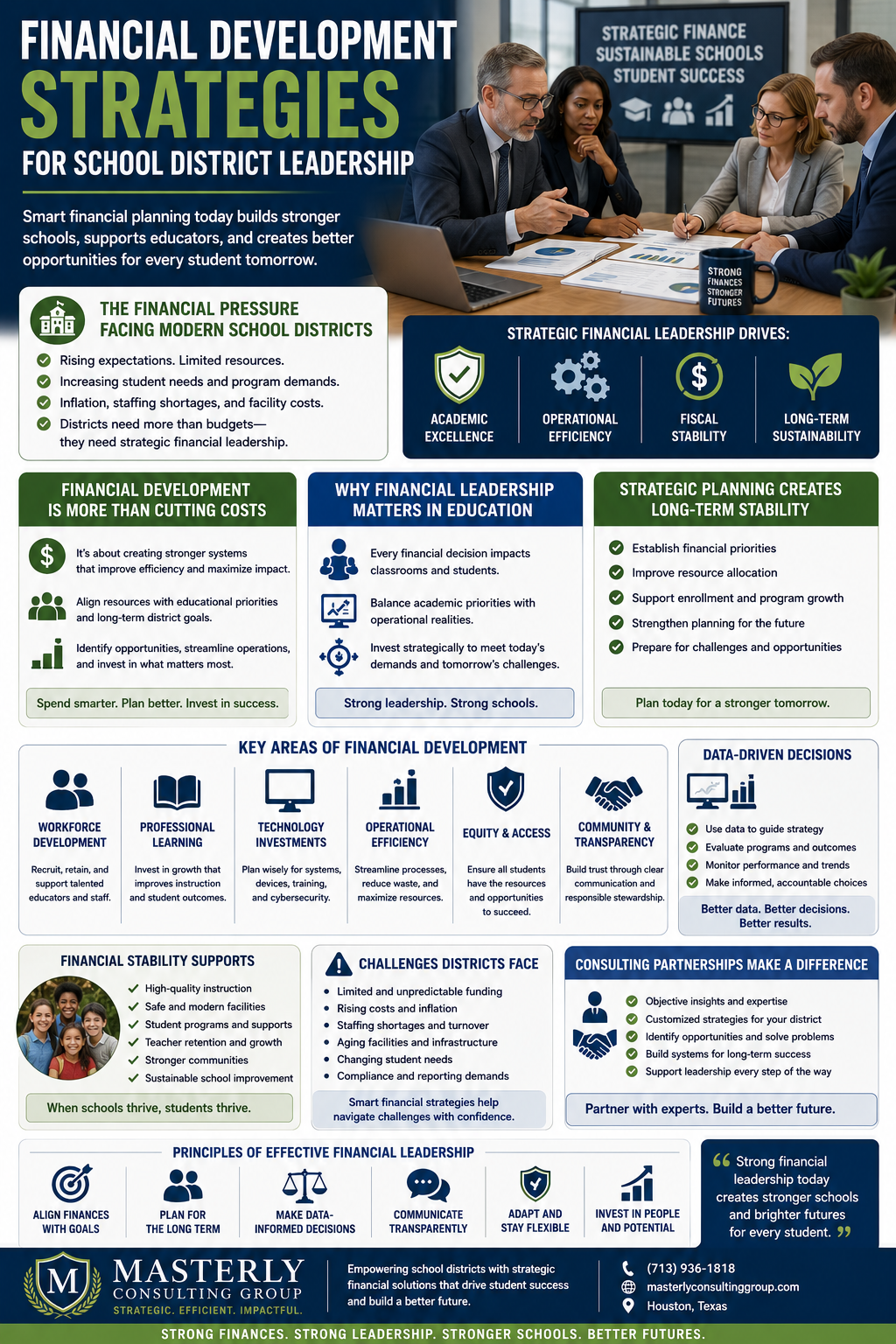
Financial Development Strategies for School District Leadership
The Financial Pressure Facing Modern School Districts
Across the country, school districts are facing growing financial pressure while trying to meet increasing expectations from students, parents, educators, and the broader community. District leadership teams are being asked to improve student outcomes, modernize instruction, strengthen safety measures, recruit talented teachers, and support expanding student needs while often working within limited budgets. These demands have forced many education leaders to rethink how financial planning connects directly to long-term educational success.
The reality is that financial development in education is no longer simply about balancing budgets. It now involves strategic planning, operational efficiency, workforce development, technology investments, and long-term sustainability. Districts that fail to adapt financially may struggle to maintain competitive programs, attract qualified staff, or support innovation inside classrooms.
At Masterly Consulting Group, we understand that financial leadership inside schools requires more than spreadsheets and budget reports. Effective education consulting focuses on helping districts build smarter financial systems that support growth, accountability, and student success over time. Strong financial strategies can help schools create stability while also preparing for future challenges and opportunities.
School leaders who approach financial development strategically often position their districts for stronger academic performance, healthier organizational culture, and more sustainable growth. Long-term financial planning has become a critical part of modern educational leadership.
Financial Development Is About More Than Budget Cuts
When many people hear the phrase financial development, they immediately think about reducing spending or eliminating programs. In reality, effective financial development strategies focus on creating stronger systems that improve efficiency while still supporting students, teachers, and educational goals.
Successful districts do not simply cut costs. Instead, they identify opportunities to improve operations, streamline processes, strengthen resource allocation, and invest in programs that produce measurable outcomes. Financial planning should align closely with educational priorities and long-term district vision.
This approach requires education leaders to think strategically about how resources are distributed across campuses, departments, technology systems, staffing models, and instructional programs. Every financial decision impacts the student experience in some way.
Education
consulting services can help district leadership teams evaluate current practices, identify inefficiencies, and develop practical financial strategies designed for long-term sustainability. Strong planning often allows districts to preserve quality while managing increasing financial challenges more effectively.
Why Financial Leadership Matters in Education
Strong leadership inside schools has always mattered, but financial leadership has become especially important in today’s educational environment. District leaders are expected to manage limited funding while still delivering high-quality education services across diverse student populations.
Effective leadership requires balancing academic priorities with operational realities. School leaders must understand how budgeting decisions affect instruction, staffing, technology, transportation, facilities, and student support systems. Financial decisions made at the district level often shape classroom experiences directly.
Many districts also face growing expectations related to equity, access, workforce readiness, and innovation. Meeting these demands requires strategic investments rather than reactive financial management. District leaders who focus only on short-term budget concerns may unintentionally limit long-term growth opportunities.
At Masterly Consulting Group, we help districts develop organizational strategy models that connect financial planning directly to educational outcomes. Strong financial leadership helps districts build stability while remaining flexible enough to adapt to changing educational demands.
Strategic Planning Creates Long-Term Stability
Strategic planning plays a major role in financial development for schools and educational institutions. Districts operating without long-term financial plans often struggle with reactive decision-making, inconsistent resource allocation, and operational instability.
A strong strategic planning process helps districts:
- Establish financial priorities
- Evaluate staffing models
- Improve resource management
- Identify funding opportunities
- Support operational efficiency
- Align budgeting with student needs
- Prepare for enrollment shifts
Strategic planning also allows district leaders to evaluate how current financial practices support long-term district goals. Rather than simply reacting to yearly budget cycles, districts can create sustainable systems supporting both academic and operational success.
Financial stability gives schools greater flexibility to invest in innovation, professional learning, and student support programs over time.
The Connection Between Financial Planning and Student Outcomes
Every financial decision inside a district eventually affects student outcomes. Staffing levels, classroom technology, transportation systems, curriculum resources, intervention programs, and instructional support all depend heavily on financial planning.
Districts with stronger financial systems often create more stable learning environments for students and teachers alike. Consistent investments in instruction, workforce development, and support services help schools maintain stronger educational performance over time.
Educational leaders must continually evaluate whether financial resources are producing measurable outcomes. This requires districts to analyze data carefully while remaining focused on long-term educational goals rather than short-term financial fixes.
Strong education strategy consulting often helps districts connect budgeting decisions directly to student performance metrics. Financial planning becomes more effective when leadership understands how operational investments influence learning environments.
Schools Must Prepare for Changing Student Needs
Modern schools serve increasingly diverse student populations with evolving academic, emotional, and social needs. Districts now support multilingual learners, students with disabilities, mental health programs, technology integration, and workforce readiness initiatives simultaneously.
These expanding responsibilities place enormous pressure on district budgets and operational systems. Financial development strategies must therefore remain flexible enough to support changing student needs over time.
District leaders should evaluate whether current systems effectively support:
- Early childhood education programs
- Academic intervention services
- Technology access
- Career readiness initiatives
- Mental health support
- Classroom resources
- Student safety programs
Without thoughtful planning, districts may struggle to allocate resources effectively across growing areas of need.
Workforce Development Is Critical for School Success
A district’s workforce directly affects educational quality, student performance, and organizational stability. Teachers, administrators, support staff, and instructional specialists all contribute to the success of schools every day.
However, many districts face significant workforce challenges involving recruitment, retention, burnout, and staffing shortages. Financial planning must therefore include talent strategy considerations designed to support educators and strengthen long-term staffing stability.
Competitive compensation matters, but workforce development also involves:
- Professional learning opportunities
- Leadership development
- Workplace culture
- Training systems
- Career advancement pathways
- Operational support
Districts investing strategically in workforce development often experience stronger employee retention and improved classroom consistency over time.
At Masterly Consulting Group, we help education leaders evaluate staffing structures, workforce systems, and leadership development models designed to support long-term organizational growth.
Professional Learning Supports Long-Term Growth
Strong schools invest continuously in professional learning because educational systems evolve constantly. Teachers and administrators must adapt to changing curriculum standards, technology systems, instructional strategies, and student expectations.
Professional learning should not function as isolated training events disconnected from district goals. Instead, it should align closely with organizational strategy, instructional priorities, and long-term improvement efforts.
Districts that invest in meaningful learning opportunities often strengthen:
- Classroom instruction
- Leadership capacity
- Technology integration
- Student engagement
- Operational consistency
- Academic outcomes
Financial planning should therefore include sustainable investments in staff growth and professional development systems.
Education Consulting Helps Districts Identify Opportunities
Many districts become so focused on daily operations that they struggle to identify opportunities for long-term improvement. External education consultants often provide valuable insights that internal teams may overlook due to operational demands.
Education consulting services may help districts evaluate:
- Budget allocation
- Staffing models
- Operational efficiency
- Program effectiveness
- Resource management
- Strategic priorities
- Financial systems
Outside expertise can also help district leadership teams evaluate challenges objectively while developing practical solutions tailored to local needs.
At Masterly Consulting Group, our consulting education approach focuses on helping districts create sustainable systems supporting financial stability, educational growth, and organizational success.
Innovation Requires Financial Flexibility
Innovation inside schools requires both vision and financial flexibility. Districts hoping to modernize instruction, improve technology systems, or expand student programs must create budgets capable of supporting innovation over time.
Unfortunately, many schools operate in highly reactive financial environments where long-term investments become difficult to sustain. Constant budget uncertainty often limits creativity and slows progress.
Strong financial development strategies help districts create room for innovation by improving operational efficiency and long-term planning. Financial stability allows schools to test new systems, expand instructional programs, and modernize classroom experiences more confidently.
Innovation does not always require massive spending increases. Often, districts simply need stronger systems for allocating resources strategically.
Technology Investments Require Careful Planning
Technology now plays a major role in education at every level. Students use digital learning platforms, teachers rely on online instructional systems, and administrators manage operations through increasingly complex software tools.
However, technology investments without proper planning can quickly create financial strain. Districts must evaluate both immediate costs and long-term sustainability before implementing new systems.
Effective financial planning should consider:
- Infrastructure upgrades
- Cybersecurity needs
- Device replacement cycles
- Software licensing
- Technical support
- Staff training
- Classroom integration
Technology systems should support educational outcomes rather than create operational burdens.
Financial Transparency Builds Community Trust
Parents, educators, taxpayers, and community partners increasingly expect transparency regarding how districts manage financial resources. Strong communication helps build confidence in district leadership and long-term planning efforts.
Transparent financial leadership includes:
- Clear budget communication
- Public accountability
- Data-driven decision-making
- Consistent reporting
- Strategic goal alignment
Districts that communicate openly about priorities and financial strategies often strengthen relationships with families and local community stakeholders.
Financial transparency also helps school leaders explain why certain investments matter and how they support long-term student success.
Strong Systems Help Districts Navigate Challenges
Every district faces challenges at some point, including enrollment changes, staffing shortages, economic uncertainty, or shifting educational requirements. Strong operational systems help districts navigate these periods more effectively.
Districts with organized financial management systems often respond to challenges with greater flexibility and stability. Reactive systems, by contrast, may create confusion, inconsistency, and operational stress.
Strong systems support:
- Budget forecasting
- Resource allocation
- Workforce planning
- Operational efficiency
- Leadership decision-making
Education consulting often focuses heavily on helping districts strengthen systems before crises occur.
Higher Education Partnerships Create Opportunities
Partnerships between k 12 schools and higher education institutions often create valuable opportunities for students, teachers, and districts. Collaborative programs may support dual enrollment, workforce readiness, leadership development, or career pathways.
Higher education partnerships can also help districts expand access to specialized instruction and professional learning opportunities. Students benefit when schools create smoother transitions into college and career environments.
District leaders should explore partnerships that support:
- Career readiness
- Workforce development
- Leadership training
- Continuing education
- Teacher preparation
Collaborative partnerships often strengthen educational ecosystems throughout entire communities.
Equity Requires Strategic Financial Planning
Educational equity remains one of the most important priorities facing modern schools. Districts must evaluate whether students across different campuses and demographic groups receive fair access to resources, support, and opportunities.
Financial planning plays a direct role in equity because resource distribution affects classroom experiences significantly. Districts should analyze whether funding systems support student needs effectively across all schools.
Equity-focused planning may involve:
- Technology access
- Intervention programs
- Staffing support
- Transportation systems
- Instructional resources
- Specialized services
Strong leadership helps ensure financial systems support fairness and opportunity for all students.
Families Want Confidence in District Leadership
Parents and families want confidence that district leadership is making thoughtful decisions supporting both financial stability and student success. Community trust often grows when district leaders communicate clearly and demonstrate long-term planning.
Families expect schools to provide safe environments, quality instruction, operational stability, and educational opportunities that prepare students for future success. Financial instability can weaken public confidence quickly.
District leaders who prioritize transparency, accountability, and strategic planning often strengthen relationships with parents and local stakeholders.
Strong communication also helps families understand how district investments support educational quality and long-term student outcomes.
Data Helps Leaders Make Smarter Decisions
Modern education systems generate enormous amounts of data related to student performance, staffing, budgeting, attendance, operations, and academic outcomes. However, collecting data alone is not enough.
District leaders must know how to analyze information effectively and apply insights strategically. Financial development strategies often improve significantly when leaders use data to guide resource allocation and operational decisions.
Data analysis may help districts:
- Identify inefficiencies
- Improve staffing allocation
- Evaluate program effectiveness
- Monitor academic performance
- Strengthen operational systems
Better information often leads to better long-term planning.
Organizational Strategy Supports Long-Term Success
Organizational strategy involves aligning leadership, operations, staffing, and financial planning around shared goals. Districts operating without coordinated strategy often struggle with fragmented decision-making and inconsistent progress.
Strong organizational strategy helps districts create:
- Clear leadership priorities
- Operational consistency
- Stronger communication
- Efficient systems
- Sustainable growth
District leaders should continually evaluate whether organizational structures support long-term district goals effectively.
At Masterly Consulting Group, we help schools and institutions develop strategies that connect leadership vision with practical operational systems.
Lifelong Learning Matters for Students and Leaders
Education should encourage lifelong learning not only for students but also for teachers, administrators, and district leaders. Educational environments continue evolving rapidly, requiring constant adaptation and growth.
Leaders who continue learning often make stronger strategic decisions because they remain informed about emerging trends, technology, instructional practices, and workforce challenges.
Lifelong learning also helps districts:
- Improve leadership capacity
- Strengthen instructional systems
- Encourage innovation
- Support organizational growth
Strong educational cultures value continuous learning at every level of the organization.
School Leaders Must Balance Competing Priorities
School leaders face constant pressure to balance financial realities with educational expectations. Districts must maintain academic quality while managing facilities, transportation, staffing, compliance requirements, and community expectations simultaneously.
This balancing act becomes especially difficult during periods of financial uncertainty or rapid enrollment changes. Effective leadership requires both strategic thinking and operational discipline.
Education consulting often helps district leaders identify practical strategies for balancing short-term operational needs with long-term educational goals.
Strong planning creates greater flexibility when unexpected challenges emerge.
Innovation and Stability Must Work Together
Some districts focus heavily on innovation while neglecting operational stability. Others become so focused on maintaining systems that they resist meaningful change. Sustainable growth requires balancing both priorities together.
Innovation should support long-term educational goals rather than create unnecessary disruption. Financial planning should therefore evaluate whether new initiatives remain sustainable operationally and financially.
Successful districts often:
- Modernize thoughtfully
- Evaluate outcomes carefully
- Support staff consistently
- Maintain operational discipline
- Adapt strategically
Strong systems create environments where innovation can succeed more effectively.
Consulting Partnerships Help Districts Move Forward
Districts facing financial, operational, or organizational challenges often benefit from outside support and objective expertise. Consulting partnerships may help leadership teams evaluate current systems while developing more sustainable strategies for future growth.
Education consultants bring outside perspectives, industry insights, and operational expertise that may help districts identify opportunities more clearly.
At Masterly Consulting Group, our team works closely with school districts, educational institutions, and education leaders to develop customized solutions supporting financial stability, leadership growth, and educational success.
Every district faces unique circumstances, which is why customized consulting support often produces stronger long-term results than generic recommendations.
Strong Financial Development Supports Student Success
At the center of every financial strategy should be students. Budget decisions, staffing models, operational systems, and leadership priorities all ultimately affect classroom experiences and educational opportunities.
Strong financial development allows districts to:
- Improve instruction
- Support teachers
- Expand student programs
- Modernize systems
- Increase operational efficiency
- Strengthen long-term stability
Districts that manage financial resources strategically often create stronger environments for both students and educators.
Educational success depends not only on academic vision but also on operational sustainability.
Building Lasting Change Requires Strategic Leadership
Meaningful improvement inside schools rarely happens overnight. Lasting change requires strategic leadership, consistent planning, organizational discipline, and long-term commitment.
Districts hoping to improve financial performance, operational efficiency, and student outcomes must create systems capable of supporting sustainable progress over time.
Strong leadership teams understand that financial development is not separate from education. It directly affects instruction, staffing, technology, culture, and long-term district success.
At Masterly Consulting Group, we help districts create thoughtful strategies supporting both operational growth and educational excellence.
How State Education Agencies Influence Financial Planning and District Operations
School districts often work closely with state education agencies when developing financial plans, implementing compliance procedures, and improving educational systems. These agencies help establish statewide standards involving funding, accountability, reporting requirements, and academic performance expectations. District leaders must understand how changing regulations and state priorities can affect budgeting decisions, instructional programs, and operational planning. Strong collaboration between schools and state education agencies may help districts identify opportunities for additional support, grants, and long-term strategic improvement. Financial development strategies become far more effective when district leadership understands how state-level decisions influence local educational operations.
Deep Expertise Helps Districts Navigate Complex Educational Challenges
Modern education systems face increasingly complicated financial, operational, and leadership challenges that often require deep expertise to address effectively. District leaders must balance workforce development, student outcomes, technology integration, compliance requirements, and budget limitations at the same time. Experienced consultants and educational advisors may provide valuable insights that help schools evaluate current systems and develop practical long-term strategies. Deep expertise becomes especially important when districts are managing organizational change, expanding programs, or responding to operational inefficiencies. Schools that seek knowledgeable guidance often position themselves more effectively for long-term growth and stability.
Funding Strategies Can Help Schools Build Long-Term Stability
Strong funding strategies are essential for school districts trying to support students, teachers, and long-term educational goals while managing limited resources. District leaders must evaluate how local funding, grants, operational spending, and program investments align with broader educational priorities. Financial planning should not focus only on short-term survival but also on creating sustainable systems that support innovation, staffing, classroom resources, and instructional growth over time. Effective funding strategies often involve careful analysis of operational efficiency, workforce needs, and future enrollment trends. Schools that plan strategically are often better prepared to adapt to financial challenges without sacrificing educational quality.
Modern School Leadership Requires a Global Leader Mindset
Today’s educational environment is more connected and competitive than ever before, which means district leadership often benefits from thinking like a global leader rather than focusing only on local operations. Students now enter a workforce shaped by technology, communication, collaboration, and international competition. Schools that encourage innovation, adaptability, and long-term strategic planning may help students prepare more effectively for future opportunities. District leaders who adopt a broader perspective often recognize the importance of workforce readiness, digital learning, and modern instructional systems. A global leader mindset helps educational organizations remain flexible and forward-thinking in a rapidly changing world.
Every Young Person Deserves Access to Strong Educational Opportunities
Every young person deserves access to educational systems that support learning, growth, leadership development, and future success. Schools play a major role in helping students build confidence, academic knowledge, communication abilities, and life readiness skills that shape long-term opportunities. District leaders must continually evaluate whether financial planning and operational decisions are supporting the evolving needs of students across different campuses and communities. Educational investments made today often influence the future success of students for many years to come. Strong leadership and thoughtful planning can help schools create environments where every young person has the opportunity to learn, grow, and succeed.
Positive Change in Schools Often Begins With Strategic Leadership
Meaningful improvement inside schools rarely happens by accident. Positive change usually begins when district leaders commit to evaluating systems honestly, identifying operational weaknesses, and implementing thoughtful long-term strategies. Schools facing financial pressure, staffing shortages, or performance concerns often benefit from structured planning and organizational support designed to strengthen stability over time. Educational leaders who embrace innovation and collaboration may help create stronger learning environments for both students and teachers. Positive change becomes more sustainable when leadership aligns financial planning, workforce development, and instructional priorities around clear educational goals.
Schools Must Help Students Build Real-World Skills
Modern education should prepare students with more than academic knowledge alone. Schools must also help students develop communication skills, critical thinking abilities, leadership qualities, collaboration techniques, and problem-solving capabilities that support long-term success. Employers increasingly seek individuals who can adapt, communicate effectively, and work productively in changing environments. District leaders should evaluate whether instructional systems and educational programs are helping students build practical real-world skills alongside traditional academic performance. Schools that invest strategically in workforce readiness and student development often create stronger long-term outcomes for both students and communities.
Education Shapes More Than Careers — It Shapes Life
The impact of education extends far beyond the classroom because schools help shape confidence, opportunity, leadership, relationships, and long-term quality of life for students and families. Strong educational systems provide students with the tools they need to pursue career opportunities, contribute to their communities, and navigate future challenges successfully. Financial planning and district leadership decisions therefore influence much more than budgets or operations alone. They directly affect the educational experiences that shape a student’s future life opportunities. Schools that remain focused on long-term growth, stability, and student success often create lasting positive effects throughout entire communities.
Effective Teaching Requires Support, Resources, and Strong Leadership
Strong teaching remains one of the most important factors influencing student success inside schools. However, teachers often need meaningful support, professional learning opportunities, classroom resources, and operational stability to perform at their highest level. District leaders should evaluate whether financial systems and organizational structures are helping educators succeed rather than creating unnecessary obstacles. Effective teaching environments usually depend on thoughtful leadership, workforce development, and long-term planning that supports instructional quality across all campuses. Schools that invest strategically in supporting teachers often strengthen both classroom performance and overall student outcomes over time.
Education Strategy Consulting Helps Schools Build Stronger Futures
Education strategy consulting helps school districts, educational institutions, and leadership teams develop long-term plans that improve operational efficiency, financial stability, and student outcomes. Strong strategic planning allows education leaders to align resources, workforce development, academic priorities, and organizational goals in ways that support sustainable growth. At Masterly Consulting Group, our education strategy consulting services help districts identify challenges, improve decision-making, strengthen leadership systems, and create practical solutions designed to support both immediate needs and long-term educational success. By combining data analysis, operational planning, and leadership development, districts can build stronger systems that better serve students, educators, and the broader community.
Contact Masterly Consulting Group for Consulting Education Services
If your district is facing financial challenges, operational inefficiencies, workforce concerns, or long-term planning issues, now may be the time to explore strategic consulting education support. Modern schools and educational institutions need strong financial systems, operational structure, and leadership strategies to support long-term student success and organizational stability.
At Masterly Consulting Group, we provide education consulting services designed to help schools, districts, and education leaders improve financial planning, operational efficiency, workforce development, leadership systems, and long-term growth strategy. Our team works closely with clients to create customized solutions that align financial planning with educational priorities and student outcomes.
Contact us at (888) 209-4055 to book a free consultation. We can answer questions regarding education consulting, strategic planning, organizational strategy, financial development, operational improvement, leadership support, and long-term growth solutions designed specifically for schools, districts, higher education institutions, and educational organizations.