Corporate Training: Building Programs Employees Can Apply After the Session Ends
Picture this: your organization invests in a two-day leadership offsite. Participants leave energized, rate the session highly, and talk about it at lunch for a week. Thirty days later, nothing has changed. Managers still default to old habits, team dynamics stay the same, and the binder from the retreat collects dust. This "training high, no behavior change" pattern is one of the most expensive problems in workforce development today.
Corporate training refers to structured learning experiences designed for employees and leaders, tied directly to business goals. It is not a generic workshop or a motivational keynote. It is a deliberate program built around specific performance outcomes: reducing risk, improving decision-making, building leadership capabilities, or strengthening organizational culture.
This article is written for companies, associations, universities, and organizations planning professional development training or compliance-related programs for staff, faculty, or executives. Masterly Consulting Group's point of view is straightforward: training must be designed for on-the-job application, not event satisfaction scores. What follows is a practical guide to designing, buying, or improving corporate training programs that deliver measurable results and help you retain talent.
What Is Corporate Training Today?
Modern corporate training is an ecosystem, not a single class. It combines live facilitation, self-paced modules, peer coaching, on-the-job practice, and reinforcement tools into a connected experience. Corporate training helps employees perform current jobs better while preparing them for what comes next.
Here is how the major categories differ in practice:
- Employee training programs cover onboarding, compliance refreshers, and skill-specific workshops. Example: a three-day orientation for new hires.
- Professional development training targets longer-term growth. Example: a six-month leadership development cohort for emerging directors.
- Corporate training is the umbrella encompassing both, always aligned with organizational performance goals.
Since around 2020, training has shifted heavily toward blended, tech-enabled, and scenario-based learning. According to SHRM's 2026 L&D Priorities report, skills gap analysis, adaptive learning, and business-aligned strategy now dominate the field. Training enhances innovation and problem-solving abilities when it is designed around real decisions rather than passive lectures.
Common training categories relevant to organizations today include leadership training, creative leadership, compliance and risk topics such as Title IX, Clery Act, and sexual harassment prevention, and core business skills like project management and communication. Strong corporate training programs align with specific performance outcomes - reducing complaints, improving project delivery, or increasing manager effectiveness scores.
Business Case: How Corporate Training Connects to Performance and Risk
Well-designed training connects directly to three pillars of business value: performance, culture, and risk management. Organizations that develop their workforce gain competitive advantage - not as a slogan, but as a measurable outcome.
The numbers support this. Companies investing in corporate training see returns exceeding 10x their investment, and companies investing in leadership training see 10x returns specifically. Organizations with comprehensive training programs have 218% higher revenue per employee, and companies offering training enjoy a 24% higher profit margin than those that don't. Training increases employee productivity by 8.6% for every 10% educational achievement. Training expenditures for large companies rose from $17 million in 2017 to $19.7 million in 2018, reflecting how seriously companies invest in this space.
Training also drives employee retention. Research consistently shows that 94% of employees would stay with a company investing in their career through training. Strong training improves company culture and collaboration, and training increases employee engagement and retention across roles and levels.
Leadership development programs enhance employee performance and adaptability while reducing execution risk. Better decision-making, clearer communication, and stronger coordination across teams mean fewer costly mistakes. Training can reduce mistakes and compliance risks in areas from project delivery to regulatory compliance. Organizations increasingly expect training to support measurable results - improved survey scores, lower turnover in key roles, stronger climate data - rather than just completion certificates.
Core Types of Corporate Training Programs Organizations Need
Organizations need different types of training for different problems. Here are the core categories, with concrete workplace examples:
Leadership training and leadership development. Leadership training prepares managers to lead teams better by replacing directive habits with coaching conversations. Leadership training fosters strong leadership pipelines, from first-time supervisors to senior directors. Creative leadership programs help leaders drive growth through innovation and design thinking. Effective leadership training improves team communication and morale.
Compliance and risk training. Sexual harassment prevention for all staff. Title IX, Clery Act, and NIL education for campus and athletics departments. Codes-of-conduct training for boards and executives. Compliance training reduces legal risk and promotes workplace safety.
Business and operational skills. Project management fundamentals - scope, schedule, budget, stakeholder management. Meeting facilitation and presentation skills for mid-level managers and emerging leaders. Soft-skills training improves communication and teamwork across departments.
Inclusive culture and interpersonal skills. Psychological safety programs focused on building trust so people speak up. Bystander intervention, conflict resolution, and inclusive leadership programs that improve day-to-day team dynamics.
Role-specific or department-specific training. Tailored programs for residence life, athletics, HR, student affairs, advancement, or corporate teams with distinct responsibilities and risk exposure. Onboarding helps new employees become productive faster. Upskilling helps employees learn new tools and processes. Technical training builds practical expertise for specific job roles.
Customized Training vs. Off-the-Shelf: When Each Makes Sense
Consider two organizations facing the same compliance requirement. Organization A purchases a generic online harassment module - employees click through it, check the box, and forget the content within a week. Organization B invests in customized workplace training built around actual incidents from their workplace, referencing their own policies and featuring scenarios their staff recognize. Organization B sees behavior change; Organization A sees only a completion report.
Customized training means programs built around the organization's policies, culture, case studies, and real-world decisions employees actually face. Customized training aligns with specific business needs and goals. Customized training increases productivity by 8.6% with 10% educational achievement because relevance accelerates application.
Off-the-shelf works for foundational awareness on broad topics or when budget constraints limit scope. Customization becomes critical when legal and regulatory frameworks are unique, when dealing with sensitive topics, or when building comprehensive programs for leadership or compliance - Title IX response protocols on a specific campus, NIL compliance in a particular conference, or complex leadership development journeys.
Masterly Consulting Group approaches customized training through discovery with internal stakeholders, reviewing existing policies, and collecting real cases to transform into interactive scenarios with customized content. The goal is not novelty - it is relevance, credibility, and immediate practical application on the job.

Designing Corporate Training That Sticks: From Needs Analysis to Application
The lifecycle of an effective program follows a clear path: needs analysis, design, content development, delivery, evaluation, and reinforcement. Corporate training programs boost worker productivity when each stage is intentional.
Start with a training consultation. Clarify the specific behavior changes you want in 3–12 months. What training objectives matter most? What does success look like in daily work? Without this step, you are building content for problems you have not verified.
Identify knowledge and skill gaps. Use interviews, surveys, complaint or incident data, performance reviews, and audits of prior training. Understand the gap between existing skills and the skills needed for target performance.
Design for application. Set 3–5 clear learning outcomes per session. Build around real decisions and scenarios - not abstract theory. Plan short practice segments rather than long lectures. Every session should move participants closer to full potential in their role.
Plan for transfer. Include tools participants can use the next day: checklists, conversation guides, email templates, or decision trees. Manager toolkits and booster sessions keep learning alive. This is the difference between training that fades and training solutions that change behavior.
Organizations should insist on programs built with modern instructional design principles that account for adult learners' limited time and need for relevance.
Instructional Design Essentials for Corporate Training Programs
Instructional design is the engineering behind effective corporate training. Without it, sessions default to slide presentations that feel productive but produce little change.
Solid instructional design translates business goals into session-level activities. Instead of a 90-minute lecture on harassment policy, instructional designers build branching case studies where participants make decisions and see consequences. Role plays, small-group problem-solving, and scenario debriefs replace passive listening.
Key principles:
- Varied learning modalities. Combine short explanations, reflection questions, group discussions, and practice with feedback to engage different learning preferences.
- Embedded micro-assessments. Polls, scenario questions, and short written responses gauge understanding in real time without turning sessions into exams.
- Personalization. Participants apply concepts to their own unit, campus, or team. In complex areas like Title IX or leadership, breakout exercises connect policy to realistic local scenarios.
Delivery Options: How Format Shapes Engagement and Impact
A one-time lecture in a ballroom creates energy. A carefully sequenced blended-learning series creates change. The format you choose shapes both engagement and long-term impact.
Common delivery methods include in-person and virtual training, and the right mix depends on your goals. In 2018, 69% of training hours were delivered using a blended learning model - a trend that has only accelerated. Virtual instructor-led sessions are a popular training delivery method, extending reach across campuses or regions. Self-paced online modules offer flexible learning experiences that accommodate different schedules and time zones.
Here is how formats compare:
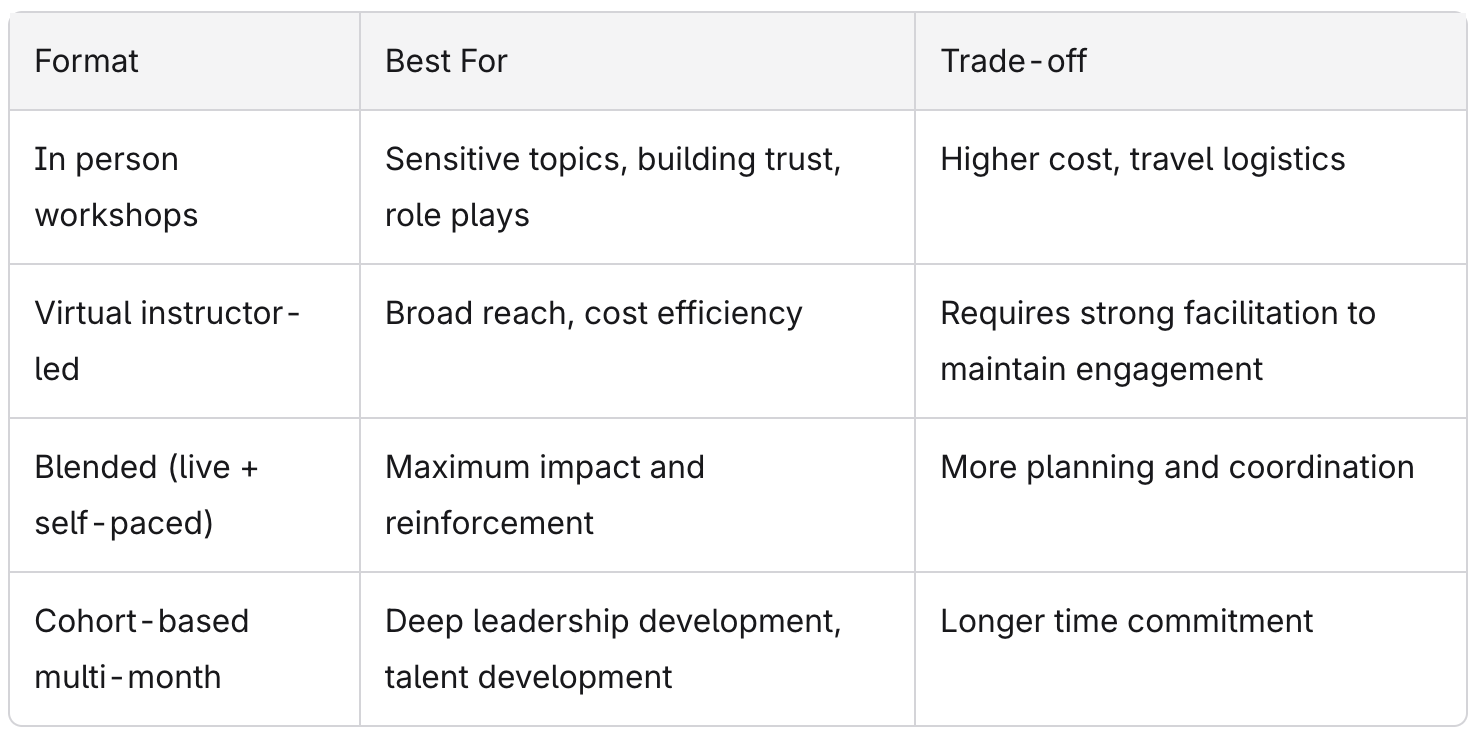
Guidance: 90-minute virtual modules spread across six weeks often outperform a single all-day retreat because they allow spaced repetition and on-the-job practice between sessions. Masterly Consulting Group emphasizes interactive facilitation in any format - chat discussions, breakout rooms, polls, and case debriefs that keep participants actively applying concepts.

Ensuring Measurable Results: How to Know Training Is Working
Most organizations track attendance. Fewer track behavior change and risk reduction. That gap is where training investments quietly fail.
Effective measurement operates on multiple levels, consistent with frameworks like Kirkpatrick's model:
- Reaction. Post-session surveys - did participants find it useful?
- Learning. Scenario-based questions - can they apply the concepts?
- Behavior. Follow-up observations and interviews - are they doing things differently?
- Organizational impact. Trend lines in complaints, climate surveys, turnover, or project delivery.
Examples of outcomes to measure:
- After leadership development: improved manager effectiveness ratings, fewer escalated conflicts, stronger employee retention in key roles.
- After compliance training: reduction in formal complaints, improved audit scores, fewer disciplinary actions.
- After project management programs: fewer missed deadlines, better budget adherence, improved stakeholder satisfaction.
Collect baseline data before training, then follow up at 3, 6, and 12 months. A top corporate training company or experienced consulting partner should help define reasonable indicators and simple dashboards rather than promising unrealistic ROI calculations.
Choosing a Corporate Training Partner: What to Look For
Selecting the right corporate training company matters as much as the content itself. Here is what to evaluate:
- True consultation up front. The partner should ask about your culture, policies, challenges, and prior training failures before recommending anything. A training consultation is the first sign of a serious provider.
- Facilitator credibility. Look for facilitators with real campus, association, or organizational experience - people who have led training in environments like yours and are comfortable with difficult conversations around harassment, compliance, or bias. Their expertise and subject-matter depth should be verifiable.
- Sample agendas and scenarios. Ask to see example scenarios and references. Did prior clients see behavior change? Were tailored solutions delivered, or was it a catalog pick?
- Post-session support. Check whether the provider offers job aids, manager toolkits, coaching, or booster sessions. Programs that end at the door rarely drive transformational change.
- Industry context. Some providers, like PTR Training, have over two decades of experience in corporate training. Look for a track record that fits your specific needs.
Masterly Consulting Group offers this kind of consultative, outcome-focused approach - helping organizations connect credible facilitation with practical, on-the-job application.

FAQ: Common Questions About Corporate Training
What is corporate training? Corporate training is any structured learning program designed for employees, faculty, managers, or board members that ties directly to business goals. It spans compliance, leadership, technical skills, and interpersonal competencies for audiences across companies, universities, and associations.
How often should we run employee training programs? Annual compliance refreshers are a minimum. Leadership cohorts typically run quarterly or over multiple months. Skill-building topics benefit from quarterly or semi-annual sessions. The cadence should match risk exposure and the pace of continuous growth in your organization.
How customized should our training be? A tiered approach works well: use core frameworks for foundational awareness, then layer in campus- or organization-specific scenarios and policies. The more sensitive or complex the topic, the more customization matters.
Can corporate training really change behavior? Yes - when design quality is high, when leadership reinforces expectations, and when you measure behavior over time. One-off events rarely stick. Well-designed programs with follow-through produce moderate to strong impact on both individual efforts and organizational performance.
How do we make sure people apply what they learn? Use action plans, manager debriefs, checklists, conversation guides, and scheduled follow-up touchpoints. Employees are your organization's greatest asset - give them the tools to communicate effectively and act on what they learned.
Virtual vs. in person training - what works better? It depends on topic sensitivity, audience size, and budget. Sensitive topics benefit from smaller, in person or virtual groups where participants can build trust. Broad skill-building scales well virtually. Blended approaches that combine both tend to deliver maximum impact.
Next Steps: Request a Corporate Training Consultation
Corporate training works when it is built for the real decisions employees face - grounded in realistic scenarios, credible facilitation, clear learning outcomes, and tools for the workplace. Your workforce deserves programs designed to drive measurable results, not just fill a calendar.
If your organization is planning leadership, compliance, or professional development training, request a corporate training consultation with Masterly Consulting Group. That conversation - typically 30 to 60 minutes - will review your current training, identify gaps, and outline potential approaches with no obligation.
Training that changes behavior is not a single event. It is a partnership. Let Masterly Consulting Group help you build programs your employees can actually use - and your organization can measure.