Business Transformation Consulting: Turning Major Change Into an Operating Plan Teams Can Execute
Introduction: When You Need Business Transformation Consulting
Most organizations do not lack for strategies, slide decks, or ambitious goals. What they lack is a concrete operating plan that connects those goals to the daily decisions of real teams. Business transformation consulting exists to close that gap-helping companies turn high-level vision into a governed, sequenced set of changes across strategy, processes, technology, and people.
The triggers are familiar. A 2024–2025 economic downturn forced restructuring. A major ERP implementation never delivered the promised ROI. A new CEO arrived in 2026 with a mandate for cost reduction and revenue growth. AI moved from experiment to competitive necessity overnight. In all these cases, the organization needs more than new ideas-it needs a transformation strategy that translates into ways of working people can actually follow.
Business transformation consulting helps organizations make fundamental changes to strategies and processes. The goal is not a generic "big bang" reorg but a structured operating model change, with governance, sequencing, quick wins, and measurable adoption baked in from the start. Companies with successful transformations are three times more likely to outperform their peers, yet 75% of business transformations fail to deliver long-term change. The difference between those outcomes is almost always the quality of the operating plan behind the transformation.
This article covers what business transformation consulting really includes, when it is needed, and how to design an operating model, roadmap, change management approach, and governance structure that produce measurable results.
What Business Transformation Consulting Really Covers (Beyond Buzzwords)
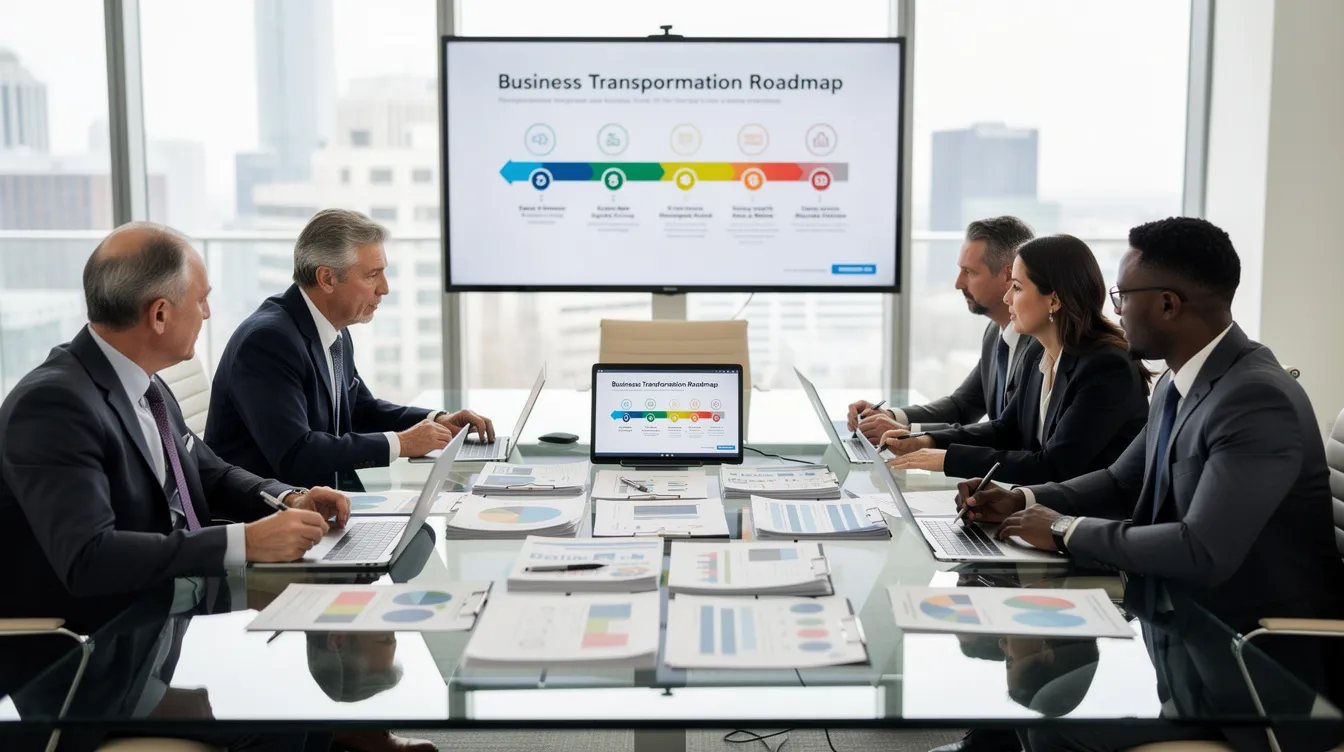
Business transformation is coordinated change across strategy, operating model, processes, technology, and culture-typically over 12 to 36 months. It is not just a software rollout, a new org chart, or a cost-cutting exercise. Business transformation involves digital adoption and operational restructuring working in concert, not isolation.
Here are the transformation lenses Masterly Consulting Group typically addresses:
- Revenue model shifts (e.g., product-based to subscription or recurring revenue)
- Cost and margin improvement across the enterprise
- Customer experience redesign organized around customer needs rather than internal silos
- Digital and AI enablement embedded into workflows, not layered on top
- Workforce and skills realignment, including new roles, upskilling, and cultural shifts
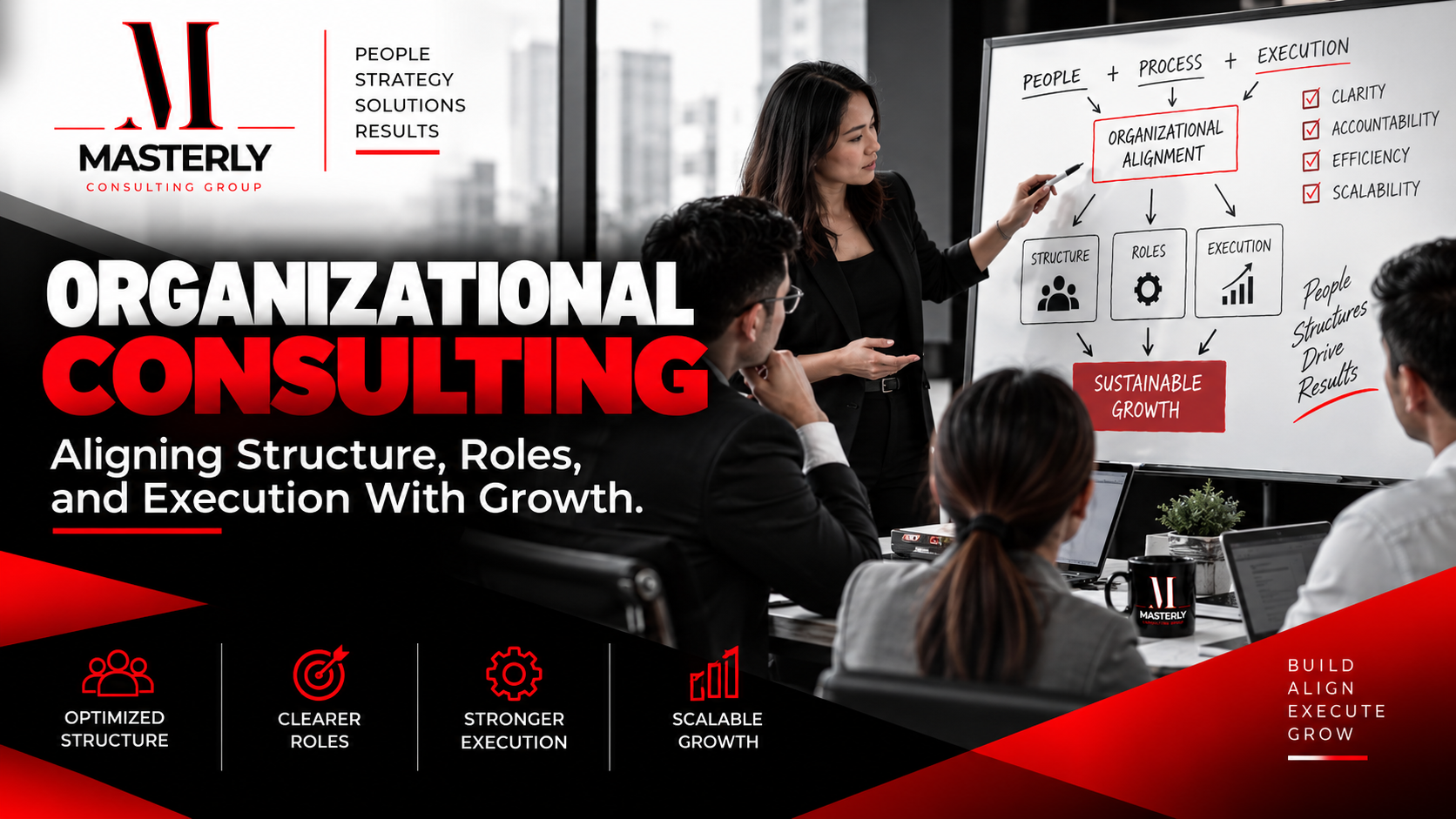
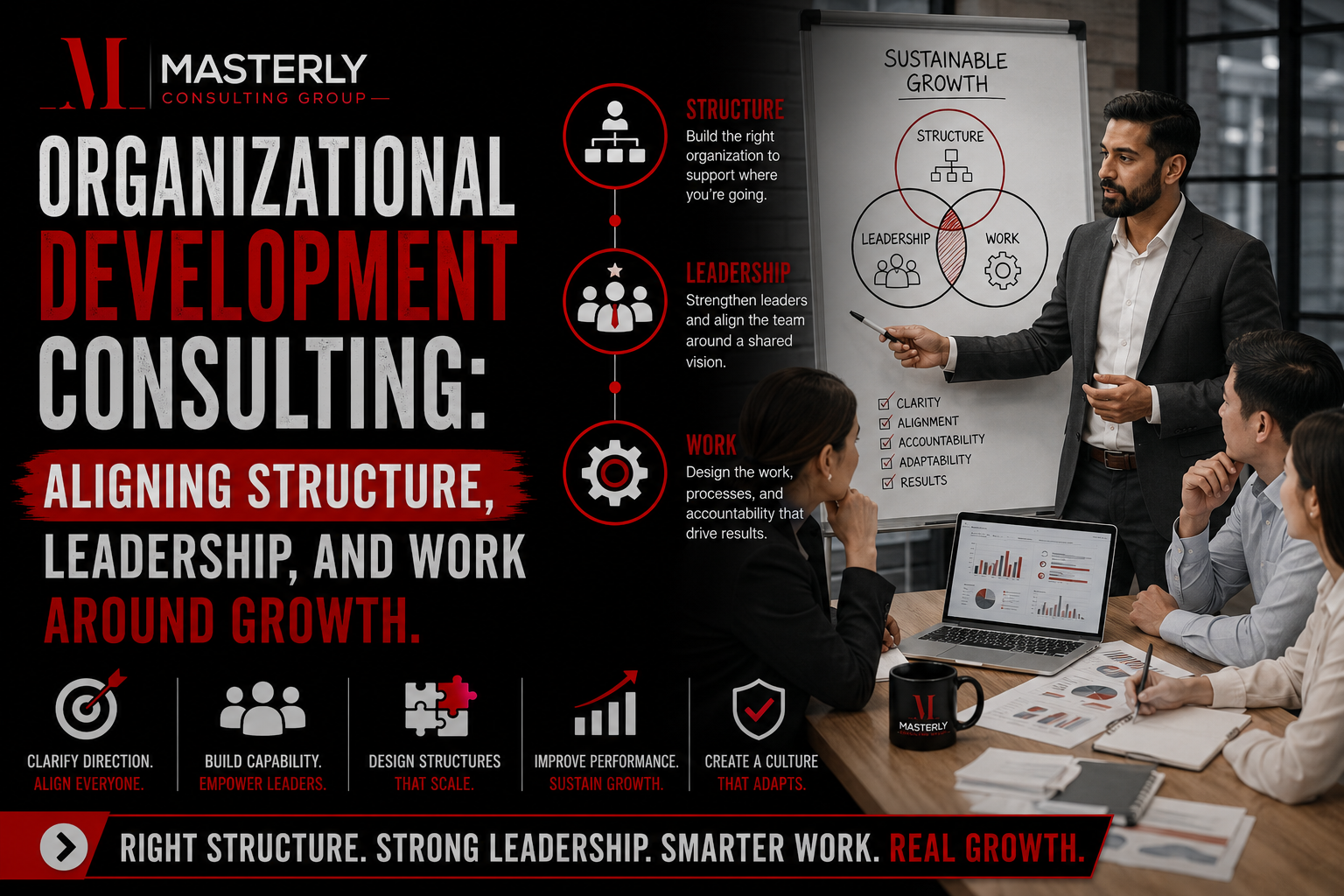
- New operating model design covering structure, decision making, governance, and accountability
Transformational consulting aims for long-term, sustainable growth and improved competitiveness-not a one-time fix. An objective of consulting is to ensure operational activities align with strategic goals at every level.
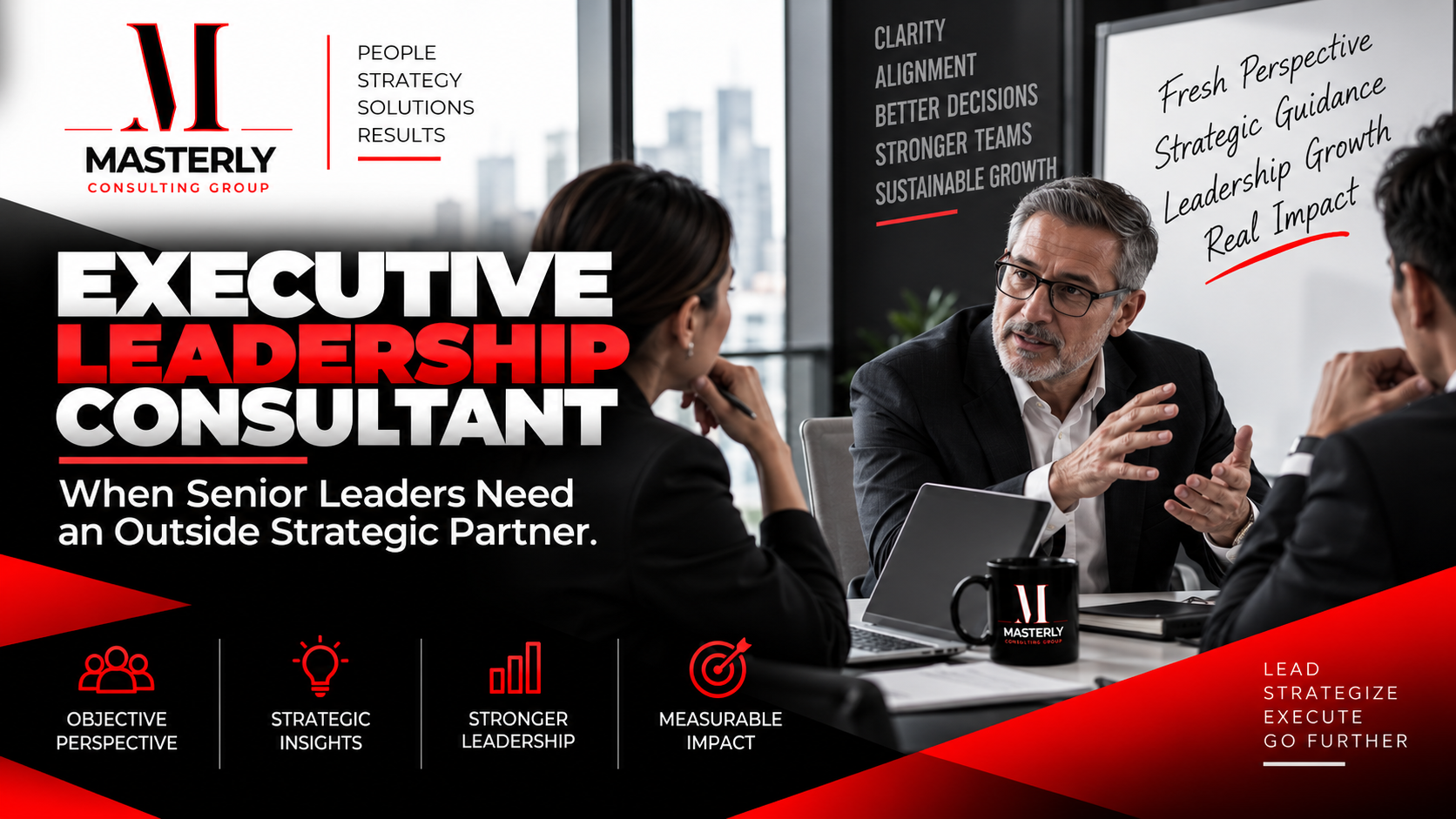
What separates a successful transformation from a failed one? Research shows that fragmented initiatives with no single owner, lack of measurable adoption, and efforts that stall after year one are the most common failure patterns. Consultants provide an unbiased perspective to identify bottlenecks and inefficiencies that internal teams may be too close to see. Business transformation consultants support execution, capability building, and benefits realization, with emphasis on co-design and capability transfer so that leadership teams retain ownership.
When to Bring in Business Transformation Consultants
Not every problem requires transformation consulting. But certain trigger situations signal that incremental improvement is no longer enough. Organizations engage consultants during mergers, restructuring, or significant market changes-moments when the entire organization must shift direction.
Common triggers include:
- A 2025 ERP or CRM implementation that consumed budget but never delivered ROI or user adoption
- Merger or acquisition fallout requiring integration of two operating models into one
- New leadership arriving with a mandate for growth, cost reduction, or operating model change
- Private-equity ownership or investor pressure demanding measurable EBITDA uplift
- Scaling from regional to national or global operations, requiring shared services or hub structures
- Pressure to adopt AI and new technologies, with 38% of executives planning to add a chief AI officer for technology integration
And here are the symptoms inside the organization that indicate help is needed:
- Key initiatives that build early momentum but stall within months
- Functional priorities pulling in different directions-sales, operations, and finance misaligned
- Constant firefighting and reactive decision making instead of planned execution
- KPIs improving in pockets but enterprise-level performance flat or declining
- Low adoption of new technologies and processes, despite significant investment
Meanwhile, 89% of organizations still use traditional hierarchical structures for transformation-structures that often create the very silos blocking change. Engaging stakeholders early is crucial for transformation success, and business transformation consulting provides the clarified value agenda, integrated roadmap, governance, and execution coaching needed to break through.
From Vision to Operating Model: Designing How the Business Will Actually Run
A clear strategy is essential, but it is not enough. Most organizations can articulate a future state-"We want to be customer-centric" or "We want to be AI-enabled"-but cannot describe the specific operating model that would make that vision real. The operating model is the bridge between strategy and daily execution.
An operating model defines, in concrete terms, how the organization runs: structure and team organization, roles and decision rights, governance forums and cadences, key processes, the technology stack, data flows, and performance management. Without clarity on these elements, strategy stays abstract and teams default to old habits.
Masterly works with leadership teams to translate a 3–5 year transformation strategy into a target operating model that can be implemented in waves-not a single disruptive switch. Design elements that are always considered together include:
- Customer journeys and value streams, organized end-to-end rather than by function
- Governance and decision-making cadence-who meets when, with what authority
- Process redesign opportunities tied to the new operating model
- Enabling technologies that support the model (ERP, data platforms, AI tools, workflow automation)
- Talent, skills, and role definitions needed to operate in the future state
- Structure decisions: product-centric vs. customer-segment model, regional vs. global hubs, centralized vs. decentralized decision making
For example, moving from a product-centric to a customer-segment-centric model changes who owns pricing, product development, delivery, and marketing. Shifting from country-based operations to regional hubs redefines the role of the regional GM and creates shared services in finance, HR, and technology. These are not cosmetic changes-they reshape resource allocation, governance, and accountability across the enterprise.

Engineering the Transformation Roadmap: Sequencing, Quick Wins, and Major Waves
A transformation roadmap is a detailed, time-phased plan with specific initiatives organized into waves-not a slide with vague "Phase 1, 2, 3" labels. It is the artifact that makes timely execution possible and keeps the entire organization aligned.
Masterly structures a 12–24 month roadmap that mixes quick wins (the first 0–90 days) with foundational initiatives (6–18 months). Quick wins build credibility and generate early momentum, while foundational work-technology platforms, data architecture, operating model adjustments-sets the strong foundation for sustained change.
Each roadmap element includes:
- A specific, measurable outcome (what metric moves, by how much)
- Named owners accountable for delivery
- Start and finish dates with clear dependencies
- Performance metrics and success criteria
- Required enablers: staffing, policy changes, technology, training
Maturity gates or checkpoints-typically quarterly-allow leadership to assess whether to scale, pause, or pivot specific initiatives. This iterative approach avoids the trap of a master plan that stalls after the first wave.
A concrete example: Wave 1 in Q1–Q2 2026 might focus on margin-focused quick wins-eliminating cost duplication, renegotiating supplier contracts, standardizing reporting. Wave 2 across 2027 could shift to customer experience redesign-mapping CX journeys, deploying AI-driven support tools, redesigning loyalty programs. Each wave feeds the next, and governance keeps them connected to strategic objectives.
Redesigning Processes and Introducing New Technologies
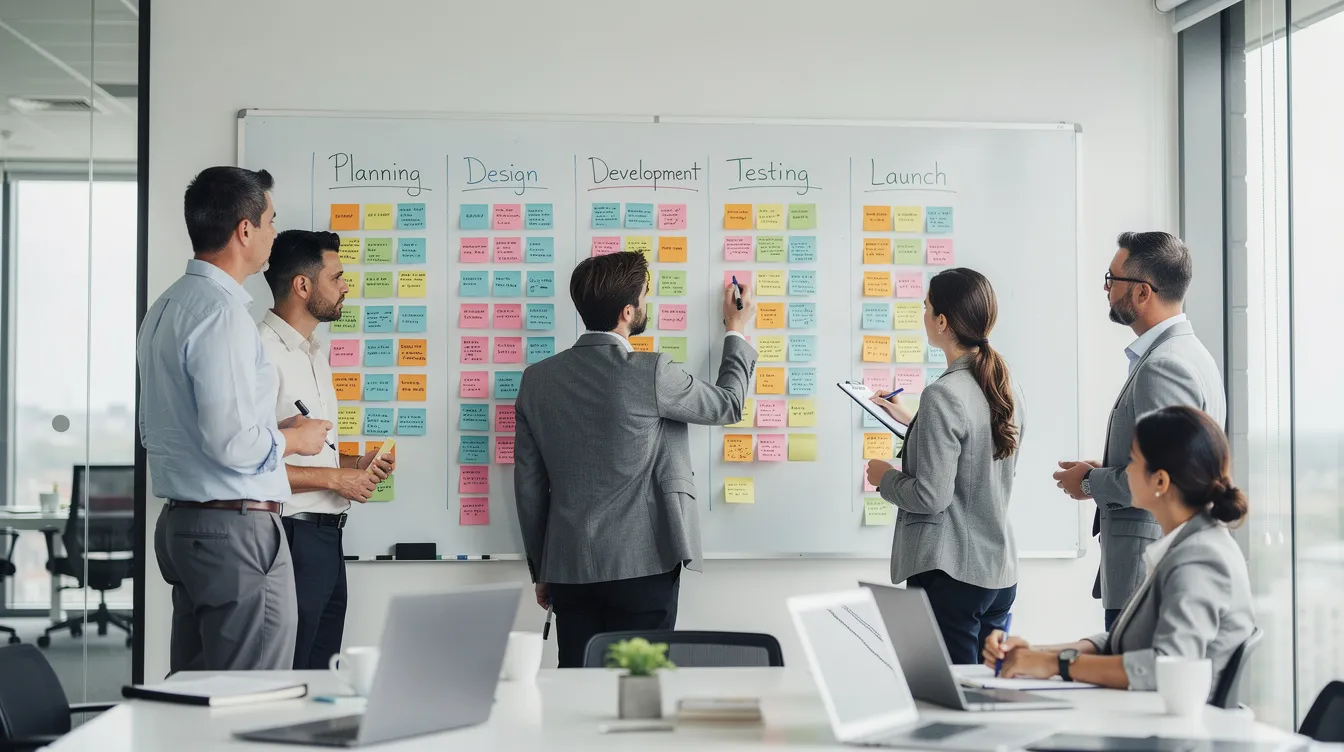
Process redesign and technology rollouts are usually where value creation is either captured or lost. Integrating technology and process changes should start during the planning stages, not after a platform is already purchased.
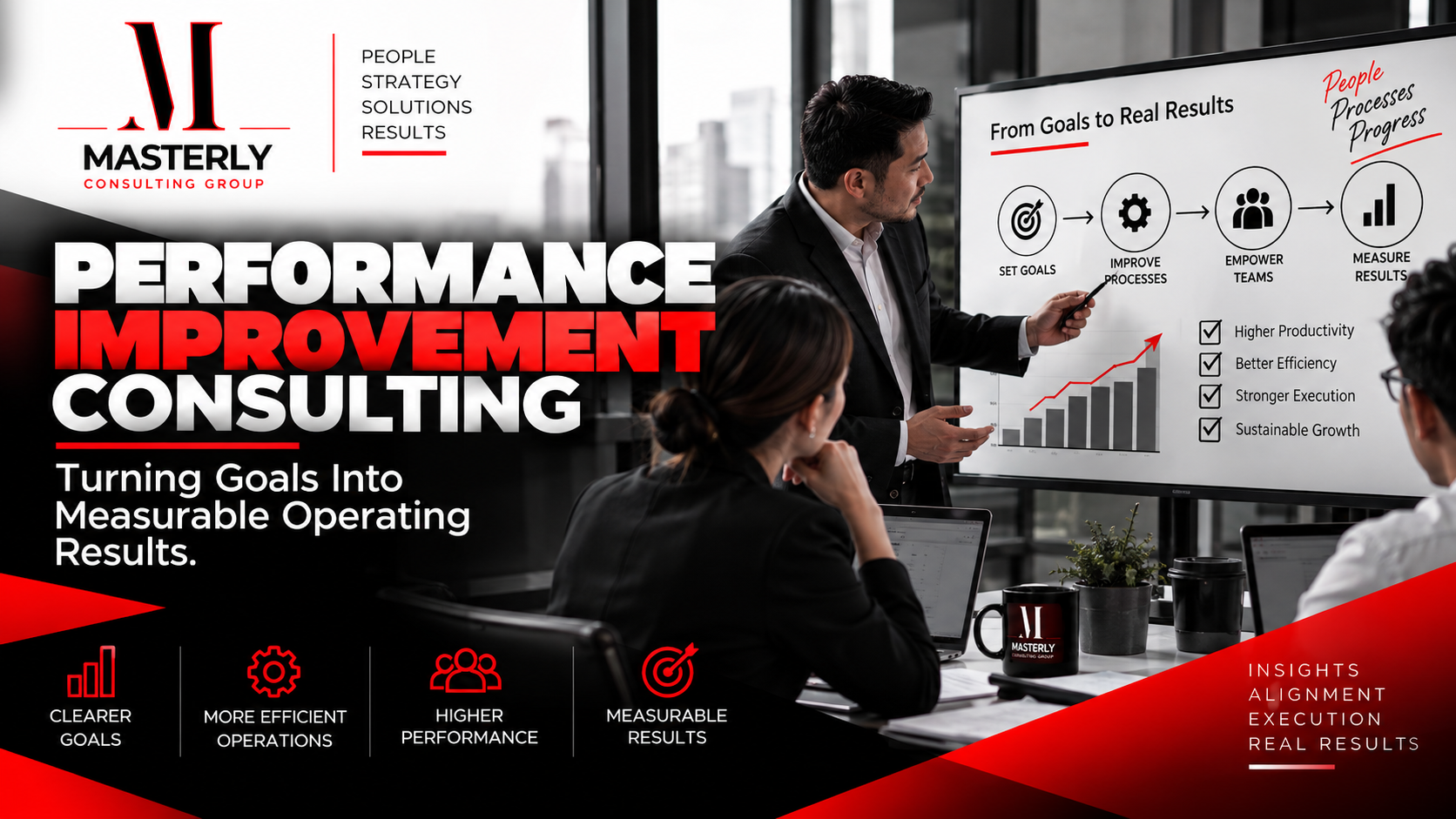
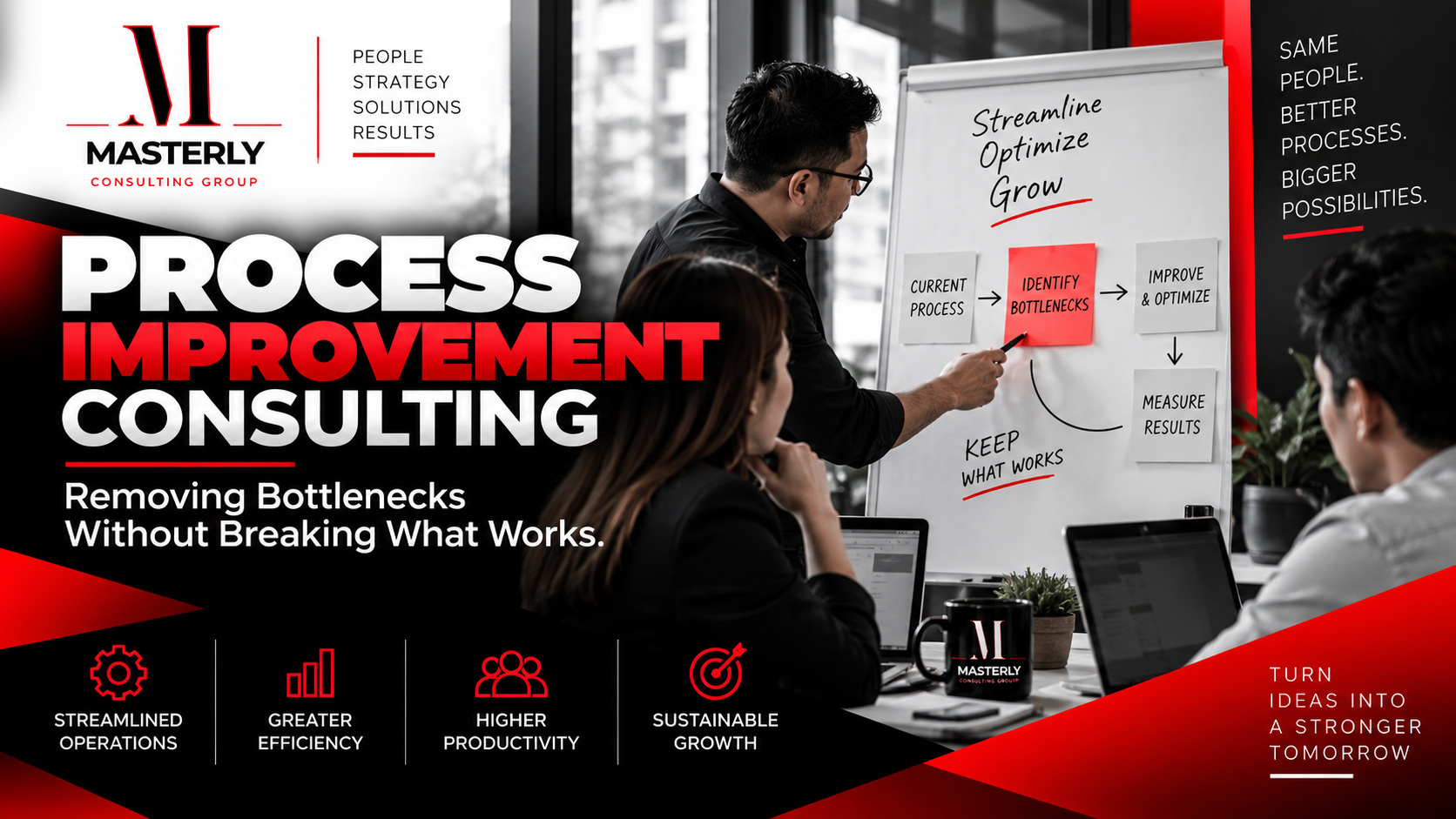
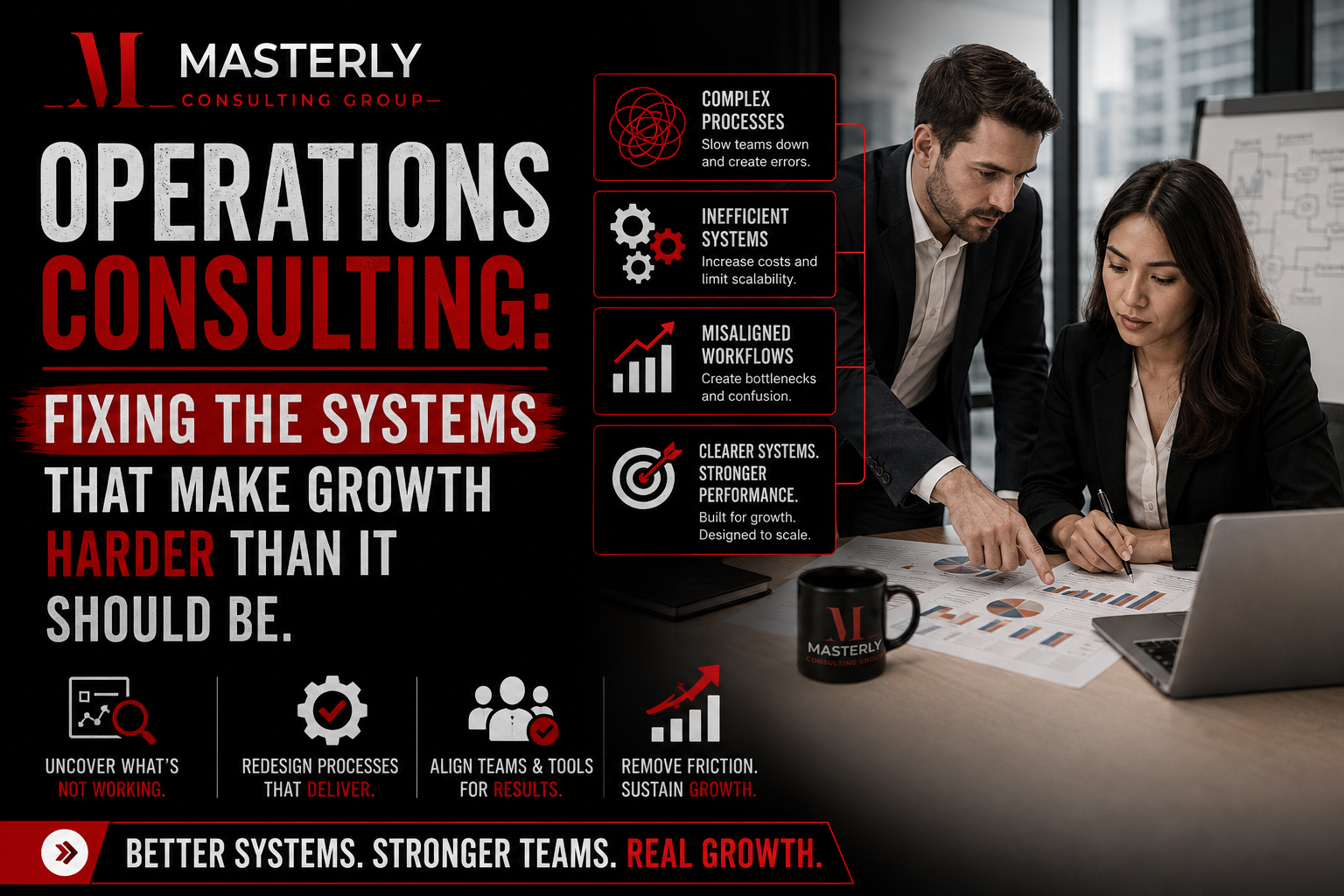
Masterly helps clients identify end-to-end processes that must be redesigned to support the new operating model-order-to-cash, quote-to-order, hire-to-retire, incident-to-resolution. Consultants analyze workflows to identify waste and implement process improvements that reduce cycle times, error rates, and handoffs.
New technologies-ERP, CRM, data platforms, AI tools, workflow automation-are selected and sequenced to support the transformation roadmap rather than running as isolated IT projects. Technology integration can improve communication and automate processes, but only when it is embedded in redesigned workflows. Business transformation consultants often utilize AI and automation in their strategies, and technology plays a central role in enabling operational efficiency and organic growth.
The link between process changes and critical outcomes must be explicit. For instance, redesigning the order-to-cash process to reduce invoicing delays, then deploying automation to support it, should be tied to measurable results like days sales outstanding or margin improvement. Improved customer experience can result from redesigning processes around customer needs rather than internal convenience.
Masterly's approach includes detailed playbooks and standard operating procedures so that redesigned processes and tools are actually adopted by front-line teams-not just documented and filed.
Change Management: Making the New Operating Model Stick
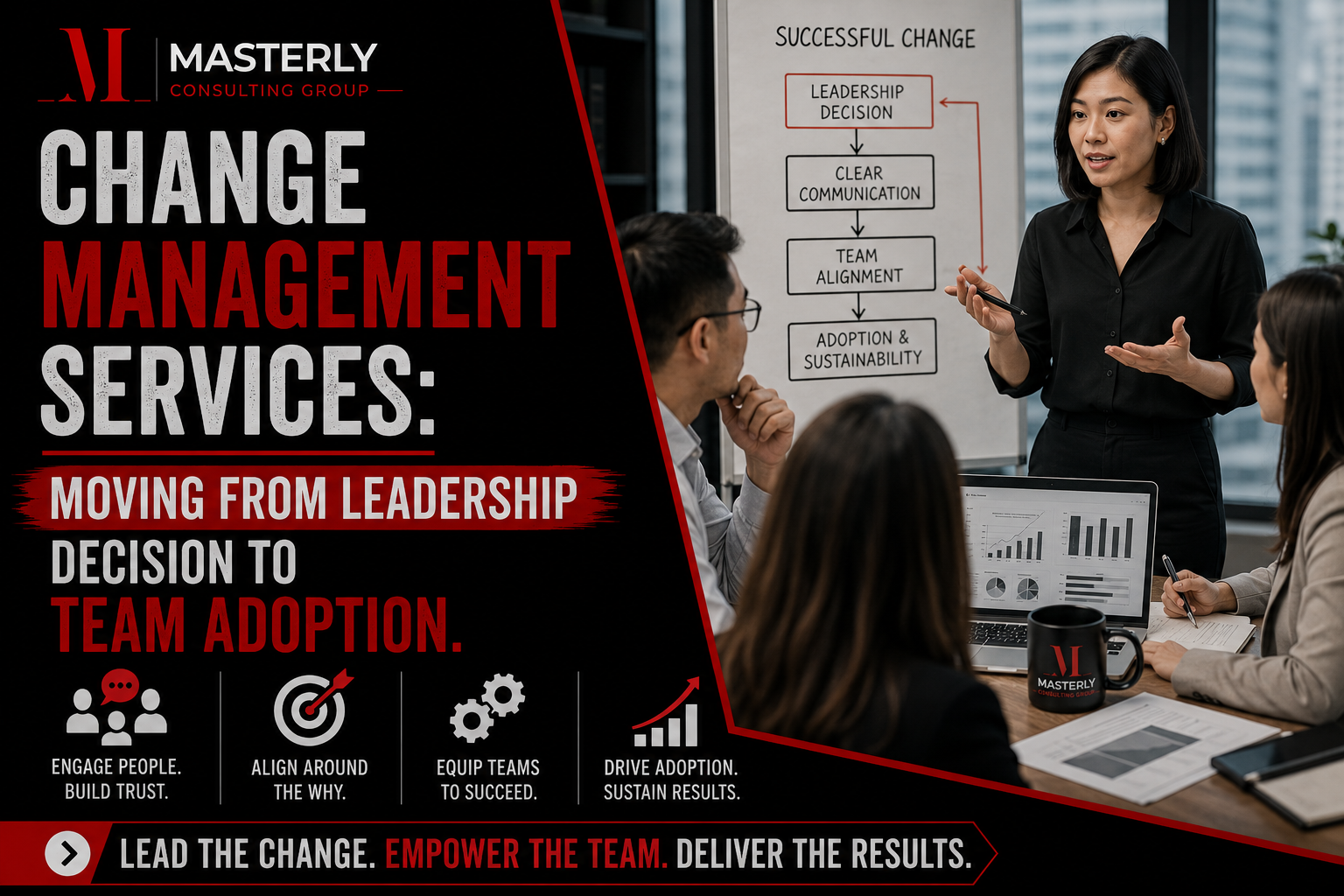
Change management is not a side project or a communications plan tacked on at the end. It is how a transformation becomes business-as-usual and avoids initiative fatigue. Change management is crucial for ensuring employee adoption of new processes, and effective change management makes organizations up to seven times more likely to meet objectives.
Specific change management activities Masterly integrates from the start:
- Leadership alignment: ensuring sponsors are clear on vision, role-model behavior, and commit personal time
- Stakeholder mapping: identifying who is affected, who resists, and who can champion the change process
- Impact assessment: cataloguing what changes in roles, systems, and behaviors
- Communication planning: consistent messaging, feedback channels, two-way dialogue
- Training design: skills, process use, new technologies, and new norms
Resistance is anticipated and addressed directly. Research indicates 41% of employees resist change due to lack of trust in leadership-a root cause that awareness campaigns alone cannot fix. Effective change management strategies address root causes of resistance through coaching managers, involving critical roles early (plant supervisors, sales leaders, regional GMs), and creating forums for honest feedback. Feedback loops and recognition programs reinforce change effectively and sustain adoption over time.
Successful transformation requires unified leadership commitment and alignment. Leaders must actively support the transition throughout its lifecycle, not just approve it at the start. Many leaders underestimate that it takes an average of 5 to 7 years to embed sustained change-making continuous improvement and reinforcement mechanisms far more important than launch-day fanfare.
Masterly helps clients build internal change capability-training change agents and embedding a transformation engine-so that many organizations can manage future operating model shifts without perpetual reliance on external consultants.
Implementation Governance: Who Owns the Transformation Day-to-Day
Without governance, even a well-designed transformation roadmap becomes a collection of disconnected projects. Governance turns the roadmap into weekly decisions, clear accountability, and a rhythm of follow-through.
Masterly typically designs a governance structure with these layers:
- Executive steering committee: sets strategy, resolves trade-offs, prioritizes funding
- Transformation management office (TMO): orchestrates across initiatives, tracks dependencies, risk, and progress
- Initiative owners and workstream leads: responsible for delivery against specific outcomes
Governance forums include weekly initiative reviews (surfacing risks, blockers, dependencies), monthly performance reviews (dashboards, resource usage, change readiness), and quarterly strategy checkpoints (alignment to strategic objectives, operating model adjustments).
Decision rights must be clarified upfront: which body can reprioritize initiatives, approve technology spend, change policies, or adjust the operating model. Without this clarity, many organizations default to escalation-by-email, and critical decisions drift.
Implementation governance is time-bound. As the new operating model is embedded, the TMO and transformation-specific forums gradually transition into standard performance management. The goal is to establish sustained organizational agility and competitiveness-not a permanent parallel structure.
Measuring Progress: How to Know If the Transformation Is Working
Transformation success requires clear performance metrics beyond one-off cost savings. Regularly reviewing performance helps sustain positive results and prevents the slow reversion to old habits that kills most change efforts.

Leading indicators (teams trained, milestones met, system login rates) provide early warning signs of stalled adoption. Lagging indicators (EBITDA, margin, market share) confirm whether business performance is actually improving. Combining both avoids overreacting to short-term noise and catches problems before they become irreversible.
A monthly transformation review dashboard might track: number of initiatives per wave, percent of milestones met, adoption metrics, customer satisfaction movement in pilot regions, financial metrics vs. target, and a risk heat map. Consultants create frameworks for tracking milestones and measuring outcomes in transformation initiatives, ensuring progress is transparent to executives, managers, and teams. Consultants help organizations achieve measurable outcomes like increased efficiency and reduced costs.
Baselines, targets, and reporting rhythms are defined early-before any initiative begins-so that performance and value creation can be tracked honestly from day one.
How Masterly Consulting Group Approaches Business Transformation Consulting
Masterly Consulting Group specializes in turning transformation strategy into an executable operating plan, with emphasis on governance, sequencing, and measurable adoption. The focus is always on building something teams can run-not producing a strategy document that sits on a shelf.
Key elements of Masterly's methodology:
- Rapid diagnostic and value mapping to identify value pockets, capability gaps, and barriers
- Operating model design co-created with leadership teams
- Roadmap and wave planning with clear owners, dependencies, and metrics
- Integrated change management embedded from the start
- Implementation governance setup with defined decision rights and cadences
- Capability transfer to internal teams so the organization can sustain continuous improvement independently
A typical engagement might begin with a 12-week diagnostic and roadmap phase, followed by 9–18 months of implementation support and coaching. Throughout, the emphasis is on co-ownership: Masterly works alongside internal leaders to develop the capabilities needed to execute-not to replace them. A business transformation consultant typically works across various sectors including healthcare and technology, and in extreme cases, across global companies and financial institutions navigating complex, multi-geography shifts.
FAQs on Business Transformation Consulting
Here are answers to questions we hear most often from leadership teams considering business transformation consulting.
How is business transformation consulting different from traditional management consulting? Traditional management consulting might deliver a strategy recommendation or an organizational redesign. Business transformation consulting goes further-it turns strategy into a transformation roadmap with governance, sequencing, adoption plans, and measurable results. The consulting services encompass operating model change, process redesign, technology enablement, and change management in a single, integrated effort.
How long does a typical transformation engagement last? Most engagements run 12 to 24 months from diagnostic through implementation. However, it takes an average of 5 to 7 years to embed sustained change, so Masterly also builds internal capability for the long term. The initial engagement is designed to achieve critical outcomes and build the strong foundation needed for ongoing evolution.
Do we need a chief transformation officer to work with you? Not necessarily. Masterly can work with an existing senior partner or executive sponsor, a PMO, or help you define the right governance structure. What matters is that someone with authority and visibility owns the transformation day-to-day.
How do you work with our internal PMO and change teams? Masterly's model is co-design and capability transfer. We integrate with your existing teams, align on governance, and support them in running implementation rather than creating a parallel structure. The aim is to implement changes your people can sustain.
What industries does Masterly Consulting Group support? Masterly works across sectors-healthcare, technology, financial institutions, manufacturing, professional services, and more. The methodology adapts to industry-specific challenges while maintaining focus on operating model design, governance, and adoption.
Can you support only the roadmap phase, or do you also help with implementation? Both. Engagements can range from roadmap design and operating model work to hands-on implementation governance and coaching. Flexibility in scope is built into how Masterly structures its consulting services.
If your organization has questions not covered here, reach out directly-every transformation is different, and the best answers are specific to your situation.
How to Get Started: Request a Business Transformation Consultation
Business transformation is a structured, governed operating model shift-not a series of disconnected projects. The organizations that achieve competitive advantage through transformation are the ones that invest in a clear operating plan, governance, and adoption path from the start. 75% of business transformations fail to deliver long-term change, but that statistic reflects how most organizations approach it-not what is possible with the right support, alignment, and execution.
If your company is entering a major technology program, facing restructuring, integrating a new leadership agenda, or preparing for an operating model change in 2026–2027, now is the time to build the plan that makes transformation real.
Contact Masterly Consulting Group at (972) 236-5051 or visit masterlygroup.com to schedule a consultation.
The right partner helps you design and execute a transformation plan that teams at every level can understand, own, and deliver.