
Brand Portfolio Strategy: Keeping Multiple Companies Distinct Without Losing Ecosystem Value
Why Brand Portfolio Strategy Matters for Multi-Company Founders
A founder launches a marketing agency in 2015. By 2019, she spins up a productized service for a specific niche. In 2023, she ships a SaaS product. Three companies, three websites, three logos. Clients ask which company they should hire. Her own team isn't sure which brand to recommend for a given project. The websites overlap. Referrals get lost.
This is what happens when a founder builds multiple companies without a brand portfolio strategy. The brands grow, but they grow without a plan for how they relate, who each one serves, and how they move customers between them.
A brand portfolio strategy is the deliberate system that decides how all the brands in a company's portfolio work together: which audiences each brand targets, what role each brand plays, and how the set of brands creates more overall value than any single brand could alone. The central tension is real: keep brands distinct enough that customers aren't confused, but connected enough that cross-referrals, trust transfer, and upsell paths still function.
This article covers brand portfolio management (how you govern and allocate resources across brands), brand architecture (the structural relationships between brands), and brand roles (the job each brand does). The focus is on roles, clarity, naming, and growth. You'll walk away knowing how to choose between a branded house, house of brands, or hybrid; how to define brand roles; how to avoid brand complexity; and how to set up a governance model that keeps your portfolio sharp.
What Is a Brand Portfolio Strategy? (and How It Differs from Just Owning a Bunch of Brands)
A brand portfolio strategy is the structured management and organization of a company's brands. It defines how brands relate to each other and target market segments, assigns each brand a unique role, and ensures the portfolio as a whole aims to cover more of the market and drive growth without wasting resources.
Owning multiple LLCs, having several logos, or running separate websites is not a strategy. Strategy answers: why does each brand exist? What audience does it serve that the other brands do not? How does the set perform financially? Each brand within a portfolio should have a clear purpose to prevent overlap.
For a founder running a core consultancy, a separate training company, and a niche product brand, a brand portfolio strategy defines each brand's unique role and ensures the three entities serve different customer segments rather than competing for the same buyers with similar promises.
This differs from product portfolio strategy, which focuses on SKUs and product categories within one brand. It also differs from generic "multi-business group" thinking, which tends to focus on operations and finance. Brand portfolio strategy zeros in on identity, positioning, and market perception. That includes company portfolio positioning: how the
parent company is perceived (or whether it is visible at all) relative to its specialist brands.
Brand Portfolio, Brand Architecture, and Brand Identity: How the Pieces Fit
Founders often blur three concepts that serve different functions. Separating them saves time and prevents misaligned decisions.
A brand portfolio is the full set of brands under common ownership. Alphabet owns Google, YouTube, and Waymo. Marriott managed 30 hotel brands after acquiring Starwood in 2016. A founder with an agency, a staffing firm, and a coaching brand has a three-brand portfolio.
Brand architecture defines the relationships between brands in a portfolio. It's the structural pattern that determines who endorses whom, what's visible to customers, and how brand names and logos coordinate. There are two main types of brand architecture: mono-brand (one name covers everything) and multi-brand (distinct brands coexist). Brand architecture helps consumers understand product offerings and their relationships, and a well-defined brand architecture enhances brand equity and consumer navigation. It also clarifies brand roles and minimizes internal competition.
Brand identity operates at the individual brand level: the name, visuals, tone, promise, and distinctive assets that make one brand recognizable. Brand positioning clarifies how each brand should be perceived in the marketplace.
Portfolio management sits above identity work. It decides which brands exist, how they relate, and where investment goes. Architecture and identity then express those decisions in ways customers can see and navigate.
Core Brand Portfolio Strategies: Branded House, House of Brands, and Hybrids
Most multi-brand ecosystems fall along a spectrum. At one end sits the branded house. At the other, the house of brands. Between them are hybrids and endorsed models.
Branded house. A branded house uses a single master brand across all products and services. FedEx (FedEx Express, FedEx Office, FedEx Ground) is a textbook example. A branded house communicates a single identity across all brands, which means equity built in one area transfers to others. The trade-off: if one offering fails publicly, the entire brand absorbs the reputational cost.
House of brands. A house of brands consists of distinct standalone brands targeting specific niches. Procter & Gamble owns Tide, Pampers, and Gillette, but most consumers never think about P&G when buying shampoo. A house of brands allows each brand to operate independently, with tailored positioning and flexibility. The cost is real: P&G invests roughly 13% of annual sales into R&D and marketing to sustain its portfolio of powerful brands.
Hybrid and endorsed models. A hybrid portfolio combines elements of multiple brand structures. Endorsed brands have sub brands supported by a parent corporate brand for credibility. Marriott operates distinct hotel brands (Ritz-Carlton, Courtyard, W Hotels) while the Marriott Bonvoy loyalty system ties the ecosystem together. Meta keeps Instagram and WhatsApp as different brands with their own audiences, connected by a visible parent.
For founders managing 3-8 companies, a lean hybrid is often the most practical choice: a credible parent brand plus a handful of clearly positioned specialist brands that share some elements but maintain distinct faces to market.

Defining Brand Roles: Keeping Each Brand Doing a Job (Not Just Existing)
Without defined roles, brands overlap, cannibalize each other, and waste marketing budget. Brand roles define what each brand is meant to achieve in a portfolio strategy, and they are the foundation of resource allocation.
Common roles in practice:
- Power brands drive profit and receive the most investment. These are the flagship offerings that generate the majority of revenue and recognition.
- Supporting brands help other brands succeed in the portfolio. A training brand, for example, might exist primarily to feed qualified leads into a consulting brand.
- Fighter brands balance out premium-priced brands in portfolios, serving price-sensitive customer segments the premium brand can't reach without diluting its positioning.
- Experimental brands test new markets or models with limited investment, protected from the expectation of immediate returns.
For a typical founder portfolio, mapping looks like this: the original agency is the power brand (broad audience, largest revenue share). A separate recruiting business is the specialist brand, serving a distinct audience. An educational brand functions as an ecosystem feeder, creating awareness and trust that leads prospects toward the higher-value offerings.
Roles inform where resources go. Power brands get the bulk of investment; specialist brands get targeted support; experimental brands receive protection but capped budgets.
Document each brand's role in 1-2 sentences: who it's for, what job it does, and how it supports financial performance. Revisit these annually.
Choosing the Right Portfolio Strategy for Your Situation
Choose architecture and brand roles based on your actual business strategy, not on what large FMCG conglomerates do. Companies with a strong brand portfolio can serve different customer groups effectively, but the structure has to match the founder's real constraints and growth plans.
Run through five questions before locking in an architecture:
- How similar are your target audiences? Heavy overlap favors a branded house or endorsed hybrid. Distinct audiences favor separation.
- How much does trust transfer matter? If credibility in one brand accelerates new offerings, keep the parent visible.
- How much risk can you tolerate? A single brand absorbs damage from any offering that underperforms. Multiple brands isolate failures.
- What marketing investment can you sustain? Each independent brand requires its own identity, content, and campaigns. A house of brands is expensive.
- How fast will you add or spin off brands? Rapid growth or acquisitions favor a hybrid with clear rules for onboarding new brands.
Steve Salis built Catalogue, a holding company with multiple restaurant and food brands. Each brand has a distinct audience, but they share operations and leadership. Market coverage allows companies to reach diverse customer segments with tailored brands, and this model gave Salis the flexibility to add new concepts without confusing existing customers.
Prototype 2-3 alternative architectures on a whiteboard. Test them with your leadership teams and a few trusted customers. The right portfolio strategy simplifies brand decisions, clarifies who buys what, and supports your planned moves over the next 3-5 years.
Managing Brand Complexity: When More Brands Help (and When They Quietly Hurt)
A successful brand portfolio strategy reduces customer confusion and improves marketing efficiency. But many organizations end up with the opposite: too many brands, duplicated websites, overlapping social feeds, and sales decks that no one can keep straight.
Symptoms of an overgrown portfolio:
- Customers unsure which brand to contact first
- Multiple websites that target the same audience with similar offerings
- Internal debates over which logo goes on a proposal
- Sales teams improvising explanations of how the brands relate
- Brands overlap in pricing, positioning, or both
Good brand portfolio strategy prevents internal competition between a company's own brands. Effective brand portfolio management reduces internal competition among brands by ensuring each brand has a distinct lane. Clarity and focus reduce customer confusion by establishing distinct value propositions for each brand.
Healthy complexity looks different: separate brands serving clearly different markets, price points, or regulatory environments. A founder running a high-touch consulting brand alongside a low-touch product brand keeps them separate precisely to protect value perception in the premium offering.
To run a quick portfolio health check, map all brands, their audiences, revenue, and roles on a single page. Flag overlaps and "orphan brands" with no clear strategic role. Simplifying doesn't always mean killing brands. It can mean consolidating under a stronger name, turning a company into a sub brand, or reframing an offering as a product line within a more powerful parent brand.

From Strategy to Structure: Designing Your Brand Architecture and Naming System
Moving from conceptual strategy ("we need three roles") to visible structure means making decisions about brand names, endorsements, visual hierarchy, and website navigation.
Start by designing a simple brand architecture strategy diagram. Plot the parent brand at the top, with sub brands and endorsed brands beneath it. For each, indicate how much of the parent's identity appears: full endorsement ("X Company, a Masterly Group brand"), light endorsement (shared footer or "part of" language), or no endorsement (standalone).
Parent and sub-brand strategy decisions depend on context:
- The group name appears on every asset when trust transfer is the priority
- The group stays in the background when specialist positioning matters more than corporate scale
- A brand stands entirely on its own when its audience would react negatively to a corporate parent, or when it operates in different industries from the rest of the portfolio
For naming, avoid near-identical brand names for brands aimed at different market segments. Use consistent naming patterns only when you want customers to sense a family. Keep legal entity names and marketing names aligned enough that contracts and customer-facing materials don't create customer confusion.
Strong architecture makes cross-navigation effortless. Someone discovering one brand should find related offerings through consistent headers, footers, "part of" signals, and ecosystem maps. This is how a brand portfolio maximizes market coverage and minimizes overlap in practice.
Aligning Brand Portfolio Strategy with Financial Performance and Resource Allocation
Brand portfolio decisions are financial decisions. Each brand consumes management attention, headcount, and marketing budget. Resource efficiency maximizes economies of scale by sharing operations within a brand portfolio, but each brand still needs to justify its existence with measurable returns.
A founder-friendly approach: segment revenue and gross margin by brand, then plot each against its strategic importance. This reveals four categories:
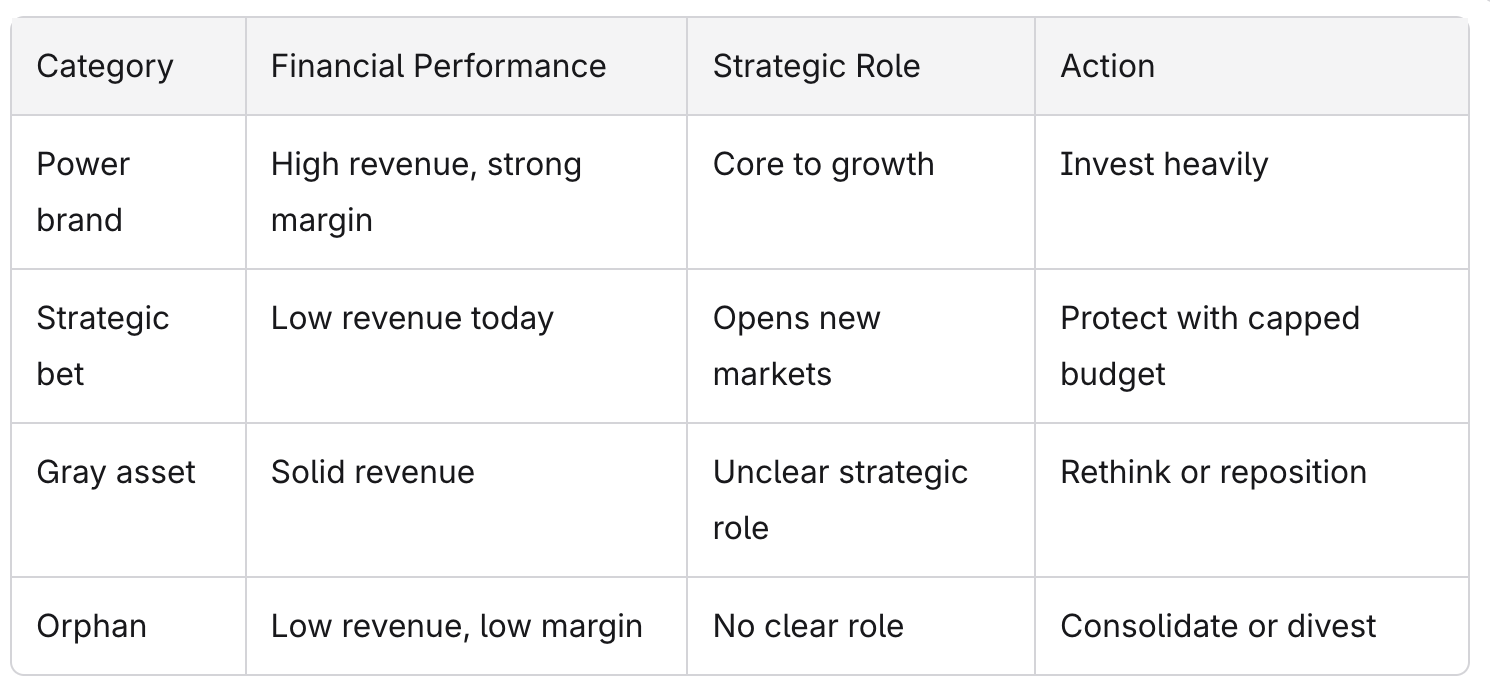
A useful benchmark: 70% of a company's revenue often comes from 25% of its brands. Knowing which brands fall into that 25% focuses investment where it matters.
Track basic KPIs for each brand: contribution to group revenue, profitability, lead volume, referral volume to other brands in the entire portfolio, and strategic value (opening new markets or customer segments).
Run an annual portfolio review where you decide for each brand: invest, maintain, reposition, consolidate, or divest. This is portfolio management in practice, not an abstract exercise. It directly drives profitable growth by ensuring resources go to strong brands with clear roles.

Creating Ecosystem Referrals and Cross-Brand Pathways Without Confusing Customers
A well-managed brand portfolio can multiply overall value by moving the right customers between brands. Instead of forcing every need into one company, you create defined pathways that serve customer expectations at each stage.
Start by mapping "ideal referral flows." For example: a training brand builds awareness and trust, then refers qualified prospects to a consulting brand for implementation. A broad, low-priced offer captures attention, then routes buyers with deeper needs toward a specialized, high-value brand.
In practice, referral pathways work through:
- Shared "About the group" pages that show how all the brands connect
- Cross-links between websites with clear context ("If you need ongoing advisory support, our sister brand handles that")
- Consistent language in sales calls so the handoff feels natural, not like a redirect
Smart ecosystem referrals differ from confusing cross-selling. Keep each brand's core promise intact. Only introduce sister brands when it clearly serves the customer's next step, not when you're trying to fill a pipeline.
Competitive defense blocks competitors by occupying shelf space or digital real estate. When your portfolio covers adjacent needs, customers stay within your ecosystem rather than searching elsewhere.
Back referrals with internal agreements: defined rules for lead sharing, incentives that prevent internal competition, and shared CRM tags indicating which brand originated each relationship. Internal alignment keeps the system honest and measurable.
Governance: Who Owns Brand Portfolio Strategy and How to Keep It Updated
Portfolio strategy cannot be a one-time workshop. Without light governance, brands proliferate, roles blur, and the portfolio drifts.
Typical ownership for small and mid-size groups: the founder or CEO serves as the ultimate decision-maker, supported by a cross-brand leadership group (heads of each company or service line) meeting quarterly.
Decisions that belong at the portfolio level:
- Creating or retiring brands
- Changing architecture or naming conventions
- Shifting investment between brands
- Setting shared identity rules
Risk mitigation isolates market failures to a single brand, protecting overall corporate identity, but only when the architecture is reviewed regularly enough to catch drift.
A practical annual rhythm works like this: review brand roles and brand performance against financial data. Refresh architecture diagrams. Update websites and messaging. Check whether consumer markets or competitive conditions have shifted enough to require a strategy change.
Document portfolio principles in a short "brand portfolio playbook" so new leaders, partners, and brand managers understand how the ecosystem works. This reduces ad hoc brand creation and keeps strategic focus intact.
Next Steps: Applying Brand Portfolio Strategy in Your Own Ecosystem
Treating your collection of companies as a deliberate portfolio unlocks clarity, growth, and resilience. It replaces ad hoc sprawl with a system where each brand strengthens the others.
Action checklist:
- Inventory your current brands: name, audience, revenue, margin, and positioning for each
- Assign provisional roles (power, specialist, experimental, legacy)
- Sketch 2-3 architecture options on a single page
- Run a quick financial and audience overlap review
- Choose a "good enough" direction and pilot it over the next 12-18 months
A winning brand portfolio strategy is not about creating the perfect diagram. It's about making every brand do a clear, valuable job, so the entire brand ecosystem creates more value than scattered, independent companies ever could.
Explore the Masterly ecosystem and its specialist companies to see how a coherent, multi-brand group works in practice.

FAQ: Practical Questions Founders Ask About Brand Portfolios
How many brands are too many for a founder-led group?
There is no universal number, but track whether each brand has a distinct audience, a defined role, and measurable financial contribution. If you cannot articulate what a brand does that no other brand in the portfolio covers, it may be redundant. For most founder-led groups with 3-8 brands, the test is whether you can explain the entire portfolio to a new hire in under five minutes.
Should I use the parent brand publicly or keep it behind the scenes?
If your parent company adds credibility (scale, track record, shared values), make it visible through endorsements. If your individual brands serve audiences that would find a corporate parent irrelevant or off-putting, keep the parent in the background. Many founders start behind the scenes and introduce the parent brand as the portfolio matures.
How do I handle inherited brands after an acquisition?
Audit the acquired brand against your existing portfolio. Does it serve a different market segment, or does it duplicate what you already have? Decide whether to keep it standalone, endorse it with your parent, merge it into an existing brand, or retire it. Marriott managed 30 hotel brands after acquiring Starwood in 2016 and spent years rationalizing overlaps.
What is the relationship between brand portfolio management and brand architecture?
Brand architecture is an output of portfolio decisions. Portfolio management determines which brands exist and what roles they play. Architecture translates those decisions into visible structure: naming, endorsements, and how customers navigate between products and services.
When should I bring in outside support for brand portfolio strategy?
When your portfolio crosses three or more brands, when customer confusion surfaces in sales conversations, or when you plan an acquisition or new brand launch. These are inflection points where an outside perspective can accelerate decisions that internal teams struggle to resolve on their own.