Performance Management Consulting: Turning Expectations Into Measurable Accountability
Performance management consulting focuses on designing and improving the systems an organization uses to set clear expectations, measure results, provide feedback, and hold people accountable. It is not about buying new software or reformatting review templates. It is about building an employee performance system where every manager and employee knows what "good" looks like, how progress is tracked, and what happens when performance falls short or exceeds targets.
Annual performance reviews are still common in many organizations, but a review is only one tool inside a larger performance management system. Performance management is the ongoing process of goal setting, regular check ins, continuous feedback, coaching, and consequences. Performance management consulting replaces outdated annual reviews with continuous feedback, and it aligns workforce performance with strategic goals. Strategic alignment ensures employees understand how their work contributes to organizational goals.
When should an organization consider a performance management system review? Four situations stand out: employee engagement scores that have been flat since 2022 despite new tools; inconsistent ratings across departments where identical work receives different evaluations; surprise resignations after annual reviews that blindsided both HR and leadership; or growing legal and employee-relations risk from undocumented performance issues. Masterly Consulting Group treats performance management as a strategy for leadership accountability and measurable expectations, not an HR paperwork exercise.
The Business Case: Why Performance Management Systems Fail in Practice
Consider an organization that invested in modern HR technology between 2022 and 2025. Dashboards exist. Reviews are digitized. Yet managers still apply different standards to the same roles, engaged employees leave because feedback arrives once a year, and "shadow standards" define success differently depending on the team. Performance management systems should provide ongoing, interactive feedback, but many do not.
Five failure patterns recur across industries:
- Overreliance on the annual performance review with little or no ongoing feedback.
- Vague competency models and goals that do not tie to actual business outcomes or customer value.
- Ratings inflation or "everyone meets expectations" masking real performance differences.
- Inconsistent application of standards across teams, creating fairness and equity issues.
- Leaders not trained or held accountable for coaching, documentation, and tough conversations.
These gaps show up in hard numbers: delayed projects from misaligned priorities left unchanged, margin erosion from unaddressed underperformance, preventable quality issues, slower decision-making, and regrettable turnover of top talent. Standardized performance metrics reduce bias in evaluations and performance ratings, but only when the system enforces consistency. Performance management consulting helps organizations continuously improve processes and operations by connecting strategy to daily management behavior.
Key Components of an Effective Performance Management System
An effective performance management system is an integrated framework of policies, tools, routines, and leader capabilities. It is not a single platform. A performance management system tracks employee performance consistently across all roles and levels. These systems can be implemented in cloud or hybrid environments, depending on the organization's infrastructure.
The key components that consulting engagements assess and redesign include:
- Measurable expectations: role clarity, job success profiles, and behavioral standards so employees feel confident about what is required.
- Goal setting: use of SMART or OKR-style goals tied directly to strategic priorities; performance metrics should be relevant, measurable, actionable and strategic.
- Regular check ins: a defined cadence (monthly one-on-ones, for example) with clear agendas covering progress, obstacles, and coaching.
- Continuous feedback: guidance, recognition, and course corrections delivered in real time rather than stored for year-end.
- Performance reviews: structured, defensible performance assessments that synthesize evidence from the full review cycle.
- Development planning: linking training and development needs to performance data so resources target the right gaps.
- Consequences and rewards: differentiation for top, solid, and under-performance, including promotion and compensation decisions.
- Data and documentation: consistent templates, note-taking practices, and calibration meetings to reduce variance.
Effective performance management combines strategy, data analytics, and change management. It is both "hard" (processes and metrics) and "soft" (manager skills, trust, and psychological safety). Effective performance management systems enhance overall workforce productivity when these components work together. Our consulting engagements map current practices against these components to identify areas where redesign will have the most impact.

How Performance Management Consulting Engagements Typically Work
A typical engagement starts with a partnership between the consulting team, executives, and HR professionals. The focus is on understanding how the current performance management process operates in practice, not just on paper. Consultants analyze and optimize measurement systems for employee performance, and they help organizations design fair and consistent performance evaluation frameworks.
The main phases include:
- Discovery and diagnostics: interviews with leaders and employees, review of current policies and performance review forms, analysis of HR and engagement data from the past 12 to 24 months. This phase typically spans 8 to 12 weeks for small-to-medium organizations.
- System design: clarifying principles, defining the structured framework, and outlining decision rules for goals, feedback cadence, reviews, and documentation.
- Pilot and refinement: testing new tools and routines in one or two departments, gathering feedback, and adjusting before enterprise rollout. Pilots usually run two to three months.
- Organization-wide rollout: training managers and employees, updating systems, and launching a clear communication campaign. Full rollout takes three to six months after the pilot.
- Sustainment and accountability: establishing metrics, leader scorecards, and ongoing calibration or coaching support.
Consultants support cultural shifts to foster continuous performance improvement throughout each phase. The system we build is designed to be run by internal HR and leaders after the engagement ends; the goal is capability, not permanent consultant dependence.
Goal Setting and Alignment: Turning Strategy Into Daily Work
Goal setting is foundational in a performance management system, and it is one of the most common sources of frustration when poorly done. Vague objectives like "improve customer service" give employees nothing to measure against.
A performance management consultant helps leaders:
- Translate organizational goals (for example, 2026 revenue targets or service-level benchmarks) into cascading team and role-level goals.
- Replace vague goals with measurable ones: reduce response time by a defined percentage, improve NPS by a specific number of points, or meet turnaround standards tied to a deadline.
- Decide on the right combination of annual goals, quarterly objectives, and shorter sprint targets for agile or project-based teams.
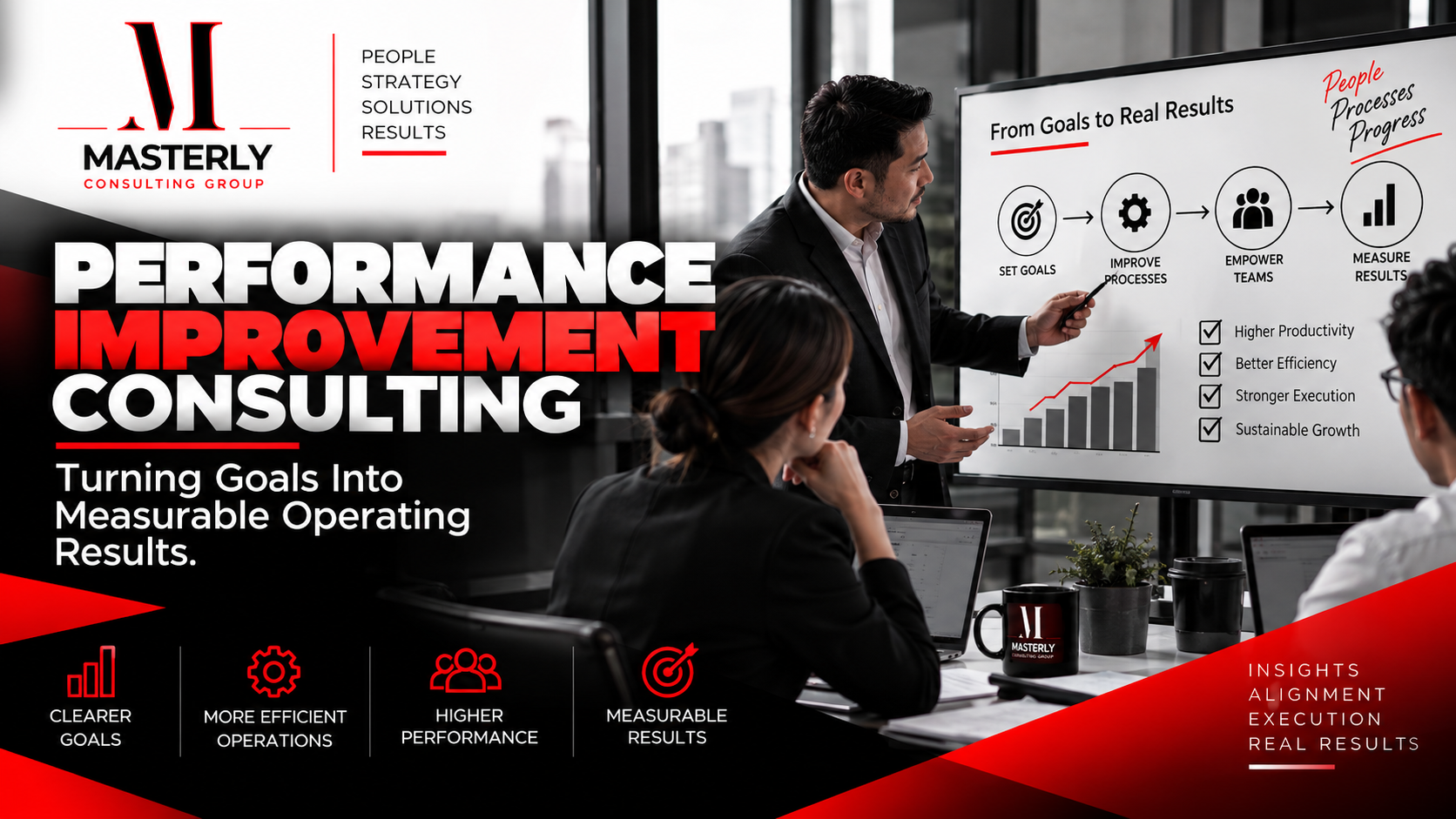
Effective goal setting involves establishing SMART goals. SMART stands for Specific, Measurable, Achievable, Relevant, Time bound. Clear communication of goals enhances employee engagement and performance because employees understand what they are working toward and how success is defined.
A uniform goal-setting cycle (annual planning with quarterly reviews) supports regular check ins and ongoing feedback. Regular check ins help adjust goals to align with changing priorities. For cross-functional and matrixed roles, shared objectives and joint accountability prevent finger-pointing and keep teams aligned. Well-designed goal setting also supports fair performance appraisals and clearer decisions on promotions, rewards, and employee development opportunities.
Building a Feedback Cadence: From Annual Reviews to Ongoing Conversations
The traditional model of providing feedback once a year during a formal review creates blind spots. Continuous performance conversations replace punitive annual reviews in modern performance management. An ongoing dialogue between managers and employees keeps an employee's work visible and correctable in real time.
Performance reviews provide structured feedback to employees, and regular performance reviews enhance employee engagement and productivity. Continuous feedback improves employee performance and engagement because problems are addressed before they compound. Regular check ins enhance real-time feedback and coaching, and they improve employee engagement and performance alignment.
Performance management consulting helps organizations define minimum expectations for manager-employee one-on-ones, train managers on how to give constructive feedback and recognition without micromanaging, and design a fit-for-workload feedback rhythm that avoids both extremes of daily hovering and annual silence. Ongoing feedback fosters a culture of continuous learning and development, and it helps employees stay aligned with organizational goals. Engaged employees who receive consistent, structured feedback are less likely to be surprised at review time.
Handling Underperformance and Difficult Performance Situations
Unclear expectations and inconsistent consequences are the most common leadership accountability breakdowns. When addressing issues around underperformance, managers are often improvising because the company has no standardized process for these conversations.
We help clients design and implement:
- Early-stage coaching conversations grounded in documented examples and measurable expectations, providing guidance before situations escalate.
- Transparent use of a performance improvement plan that is supportive, time bound, and specific. A Performance Improvement Plan outlines areas for employee improvement. PIPs provide a timeline and resources for performance improvement. The goal of a PIP is to assist employees, not punish them. PIPs help maintain high-performance standards in organizations.
- Escalation pathways and documentation standards that prepare the organization for corrective or disciplinary actions, including termination decisions, when required.
The balance between fairness and accountability requires two conditions: ensuring employees understand expectations and have access to reasonable support, and ensuring leaders are equipped and required to act when performance consistently falls short. Defensible processes, consistent documentation, and partnership with internal HR and legal reduce employee-relations risk. A clear, practiced system means managers are not guessing in high-risk situations.
Using Performance Data to Inform Training and Development
An effective performance management system does more than evaluate people. It reveals patterns that should drive training and development investments. Performance reviews help identify training and development needs, and performance management systems help identify training and development needs at the organizational level.
Performance management consulting helps organizations:
- Identify recurring skill or behavior gaps across roles or departments using performance review data, check-in notes, and 360 feedback where applicable. Identifying skill gaps supports targeted employee development programs.
- Distinguish between individual performance issues and systemic capability gaps (for example, many supervisors struggling with coaching or documentation).
- Design development plans at three levels: organization-wide programs, team-level training, and individualized learning plans connected to review outcomes.
Training managers on feedback techniques enhances management effectiveness. Using data-driven metrics aids in measuring performance objectively, which means training budgets go toward the few capabilities that most affect results rather than generic programs. Higher retention rates result from investing in employee growth and recognition. Effective performance reviews correlate with merit pay and promotions, giving employees a clear line between performance and career progress. When development opportunities are tied to transparent performance criteria, employees feel the system is fair and are more motivated to develop new skills. Simple dashboards or summaries ensure training and development needs are reviewed at least annually during planning cycles, offering deeper insights into where the organization should invest.
Leadership Accountability: Making the System Work Day-to-Day
The best-designed performance management system fails if leaders are not held accountable for using it. Managing performance is a daily practice, not a quarterly checkbox.
Consulting support typically:
- Clarifies what accountability looks like for executives, directors, and frontline managers: maintaining one-on-one cadences, completing quality reviews on time, coaching underperformers with documented examples.
- Builds leadership competencies aligned with four core responsibilities: purpose (connecting roles to strategy), people (coaching and feedback), decisions (ratings and consequences), and performance (tracking outcomes and adjusting course).
- Establishes leader scorecards or simple KPIs for performance management behaviors, such as completion rates, quality of reviews, and engagement scores tied to manager behavior.
Accountability also requires support. That means training, tools, and templates for performance conversations; access to HR and leadership coaching for complex scenarios; and peer learning through calibration sessions and communities of practice. When leaders at every level are equipped and expected to manage performance consistently, organizations see clearer expectations, faster decision cycles, and improved team output. Innovative solutions for accountability tracking help the company sustain the system in the intervening years between major redesigns.
Choosing a Performance Management Consulting Partner
Performance management touches every employee in the organization, so choosing the right consulting partner matters. Evaluate firms against these criteria:
- Experience translating strategy into measurable expectations and employee performance systems, not just HR policy updates.
- Demonstrated ability to work with owners, executives, and HR leaders as an integrated team.
- A clear methodology for diagnostics, design, piloting, and rollout without forcing a one-size-fits-all performance review process.
- Practical tools for goal setting, feedback, regular check ins, and performance reviews that managers can actually use.
- Emphasis on building internal capability (training, toolkits, and leader development) rather than long-term consultant dependence.
- Willingness to connect the performance management system to measurable outcomes such as engagement, quality, speed, or client satisfaction.
Masterly Consulting Group's services center on education, system design, and leadership accountability. We evaluate what exists, identify what needs to change, and develop the internal resources to keep the system running after our engagement ends.
Next Steps: Discuss a Performance Management System Review
If your organization is dealing with unclear expectations, inconsistent feedback, or weak accountability, these are system-level issues. They do not resolve by replacing one manager or adding another form. A performance management process left unchanged will keep producing the same frustrations.
A focused performance management system review examines your current policies, tools, review processes, feedback cadence, and leadership practices against the components described in this article. An initial conversation with Masterly Consulting Group covers:
- Clarification of current challenges and goals.
- A brief discussion of your existing performance review process and feedback routines.
- Exploration of where a redesign or refinement could most quickly improve accountability and employee engagement.
Contact Masterly Consulting Group at (972) 236-5051 or visit masterlygroup.com to schedule a consultation. The goal of that first conversation is to understand fit and identify whether performance management consulting is the right lever for your situation. Turning expectations into measurable accountability starts with an honest look at the system you have.

FAQ: Performance Management Consulting
What is the difference between performance management consulting and traditional HR consulting? Traditional HR consulting often covers compliance, benefits, or policy writing. Performance management consulting focuses on the system that defines, measures, and enforces accountability for employee performance: goal setting, feedback cadence, review design, manager capability, and consequences. It is an important aspect of organizational effectiveness that goes beyond administrative HR.
How long does it take to see real changes in employee performance after updating a performance management system? Changes in feedback frequency and clarity of expectations are often visible within three to six months. Operational and financial improvements, such as reduced turnover or improved productivity, typically take 12 to 18 months to show up in the data.
Will we need new software to improve our performance management process? Not necessarily. Most organizations already own sufficient technology. The issue is usually system design and manager behavior, not the platform. We focus on how tools are used before recommending new purchases.
How does performance management consulting support both high performers and struggling employees? High performers benefit from clearer recognition, development paths, and differentiated rewards. Struggling employees receive documented coaching, structured support through a performance improvement plan, and time bound objectives that give them a fair chance to improve performance.
How involved do senior leaders need to be for a performance management overhaul to work? Active involvement from senior leaders is a prerequisite. Without executive commitment to the process, managers treat performance management as optional paperwork. Leaders set the example by participating in calibration, holding their direct reports accountable, and using the system themselves.