Organizational Design Consultant: Clarifying Roles, Decision Rights, and Accountability Before Growth Stalls
This 2026 guide from Masterly Consulting Group is written for founders, CEOs, and leadership teams searching for an organizational design consultant who can bring clarity to roles, decisions, and accountability before internal friction stalls growth. Below you'll find FAQs, real-world examples, and a step-by-step view of how consulting engagements work. If you're ready, you can request an organizational design consultation at any point.

What an Organizational Design Consultant Actually Does
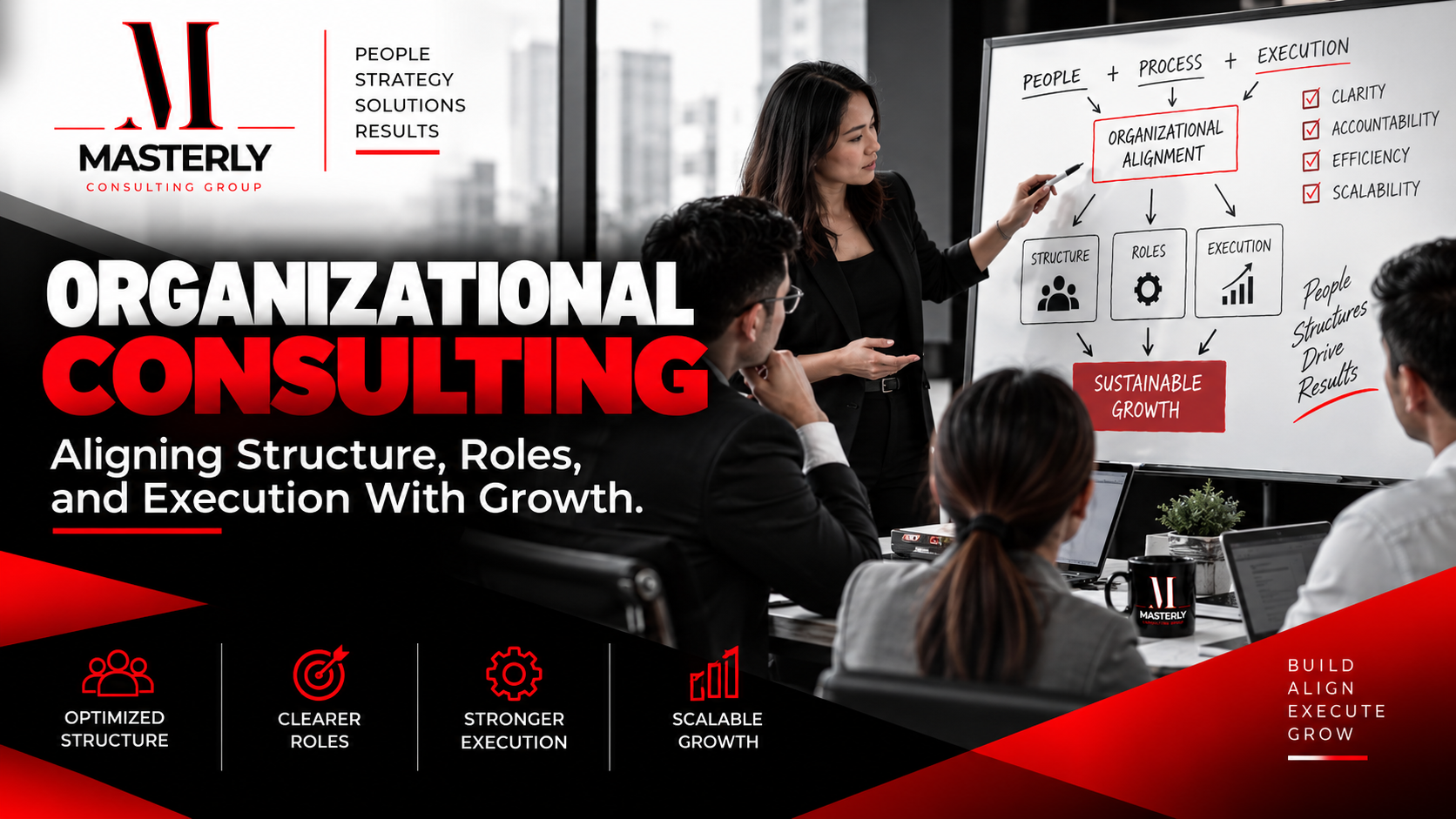
An organizational design consultant evaluates and reshapes a company's internal framework so that its organizational structure, roles, decision rights, and accountability match its business strategy and growth stage. This work goes far beyond drawing a new organizational chart. It touches core processes, information flow, leadership team structure, and how decisions are really made day to day. Organizational design involves aligning structure, roles, processes, and decision-making with business strategy, and an experienced consultant can help reduce duplicated work and unnecessary management layers in an organization.
Consider a 150-person SaaS company in 2025 that scaled quickly after a Series B. Product and engineering teams were making independent prioritization calls, causing rework, customer complaints, and missed deadlines. An operating model redesign unified prioritization through a steering council, redefined role charters, and restructured reporting so ownership was unmistakable. Within eight weeks, decision cycle time dropped by half.
Core responsibilities of an organizational design consultant include:
- Diagnose current state through interviews, data analysis, and mapping spans, layers, and decision flows.
- Design operating model options aligned with strategy, including role clarity and accountability frameworks.
- Test design options with leadership, piloting in specific functions or business units.
- Guide change management through communication plans, governance forums, and behavior reinforcement.
Organizational design consultants help define roles and accountability to reduce confusion. They clarify decision-making rights to improve efficiency and support scalability to accommodate future growth without chaos. That combination is what separates organization design work from a simple reorg.
When Your Company Needs an Organizational Design Consultant
If you're a founder or CEO leading a company between roughly 50 and 1,500 employees, there's a point where you can feel growth stalling-not from lack of demand, but from internal drag. Two-thirds of leaders underwent operating model redesigns in the past two years, which tells you this problem is widespread. McKinsey research shows that only 21% of organizational redesign efforts succeed, making it critical to recognize the signals early.
Check whether these patterns have appeared within the organization over the past 12–18 months:
- Unclear ownership of critical initiatives. No one knows who owns the product roadmap or customer experience.
- Duplicated work across functions. Sales, partnerships, and marketing all building overlapping outreach programs.
- Decisions escalating unnecessarily to the CEO. Even tactical calls require top-level involvement.
- Rework across teams. Work repeatedly handed off between functions with inconsistent outcomes.
- Chronic fire drills. Frequent emergencies that disrupt planned work and signal capacity or clarity gaps.
- Stalled growth despite strong demand. Revenue looks good, but margin or cycle time balloons.
- Leadership misalignment on goals. Unable to agree on direction, business goals, or the right structure.
- A recent growth event magnifying dysfunction. Funding rounds, acquisitions, or new product lines stress weak design under changing circumstances.
Poor organizational structure can lead to high staff turnover and low morale. If more than three of these root causes are present, a structured organizational design consulting engagement is typically warranted. Track metrics like decision cycle time, missed OKRs, and percentage of projects requiring last-minute executive intervention to confirm what you're sensing. In volatile market conditions, waiting only deepens the problem.
From Strategy to Structure: Connecting Business Goals to Design
Organizational design must start from business strategy, not from boxes on an organizational hierarchy chart. Structurally rearranging jobs without first defining what the company needs to achieve is how you get disconnected roles, conflicting strategic priorities, and wasted resources. Structure matters only when it serves the company's vision and organization's purpose.
Consultants translate strategy into design principles-speed to market, customer proximity, cost efficiency-and then into structure, core processes, and governance. For example, a consumer-tech company in 2024 shifting from pure growth to profitable growth needed accountability frameworks centered on margin and cash flow. Leadership alignment around north-star outcomes like "reduce time from concept to launch by 30%" and "increase margin on new sales by 5 points" determined whether roles should be centralized or pushed down, how many layers were needed, and which governance forums to keep or eliminate.
Companies with aligned structures are 92% more likely to meet their strategic goals. Leaders must align with redesign efforts for success-without that, even the right structure fails. Misalignment between business goals and structure is a persistent root cause of failed transformations. A consultant's job is aligning people, processes, and strategy execution to systematically close that gap. Business performance improves only when the organizational goals and the operating reality match.
Inside a Modern Organizational Design Consulting Engagement
If you've never worked with an organizational design consultant, here's what a typical engagement looks like from first call to implementation. The scope of the project includes methodology, key milestones, and resource commitments. A well-defined project timeline varies by organization size, but for a mid-market company of 400–700 employees, expect roughly 12–16 weeks from kickoff to first structural changes.
Stage 1: Discovery (Weeks 1–3) The initial consultation involves outlining current pain points and strategic goals. Key leaders-CEO, COO, HR, functional heads-align on scope. Assessing the current organization includes reviewing reporting lines, workflows, and communication patterns to identify inefficiencies. Outputs: current-state org map, gap analysis, baseline metrics.
Stage 2: Diagnostic (Weeks 4–7) Diagnostic assessment involves interviews, surveys, and reviews to identify organizational bottlenecks. Consultants map decision flows, core processes, and reporting relationships to determine where work stalls. Project management of this phase is critical.
Stage 3: Design Options (Weeks 8–11) Co-create design options with leadership. Test scenarios. Choose structure-functional, product line, geographic, or hybrid. Outputs: future-state org model, RACI matrices, decision catalogs, capability maps.
Stage 4: Pilot and Reinforcement (Weeks 12–16+) Pilot in selected business units. Plan role transitions. Build governance routines. Coach leaders.
Key activities during the engagement include discovery, diagnosis, analysis, and design recommendations. An organizational design consultant typically engages in a collaborative and data-driven approach throughout. Performance evaluations measure success against metrics established during the initial phases. Effective consultants don't disappear after the PowerPoint-they stay to ensure behavior changes and structural reinforcement take hold.

Clarifying Roles, Decision Rights, and Accountability
Role clarity and decision rights are foundational to speed, morale, and team performance. When employees don't know who decides, who executes, or who is accountable when things go wrong, delays multiply and engagement drops. Defining roles with precision is one of the highest-leverage interventions a consultant can make.
"Decision rights" specify exactly who makes a given decision, who must be consulted, who executes, and who owns the outcome. Overcentralizing decision making is a common organizational error-one that creates bottlenecks at the top while disempowering managers and direct reports closer to the work. Ambiguity in decision rights leads to high organizational costs through duplicated approvals, stalled projects, and finger-pointing.
Consultants map real decision flows-for pricing, product approval, hiring, customer discounts-and identify where decisions are stuck or made at the wrong level. One client, a logistics company in 2023, required four sign-offs for standard customer discounts: sales manager, regional director, finance, and legal. The approval cycle averaged 10 business days. After redesigning decision rights to authorize two roles for standard discounts with veto rights for exceptions, cycle time dropped to 48 hours.
Tools include RACI charts, decision catalogs, governance forums, and simple operating guidelines written for real managers. Job architecture and role charters-not just job descriptions-specify authority, decision rights, accountabilities, and performance metrics. Routine reviews of decision rights improve organizational efficiency over time and prevent drift as the company evolves. Organizations should routinely review these frameworks, especially after growth events or leadership transitions that shift skills and responsibilities across teams.
Operating Model Design and Redesign: Beyond the Org Chart
An operating model is how strategy, structure, processes, technology, and people fit together to deliver value. It decides where work happens, how resources flow, and how decisions get executed. A well-designed operating model can boost operational performance by 30% according to research, which is why organizations should regularly redesign their operating model for effectiveness, especially as business needs shift.
Operating models can vary by business unit or geography-a product-driven model in one division, a customer-segment model in another-but they must align under coherent enterprise design principles. A new organizational chart alone won't fix delays if the underlying processes and governance remain broken.
Consider the wave of digital transformations between 2022 and 2024. Many companies restructured around cross-functional pods but failed to address handoffs and governance. Only when core processes, decision rights, and coordination routines were redesigned-a full operating model redesign-did delivery speed actually improve. A decade ago, most companies defaulted to functional silos. Today, improving cross-functional collaboration involves breaking down silos within the organization to create end-to-end ownership.
Common design choices include:
- Centralization vs. decentralization: Shared services reduce cost; embedded teams increase speed.
- Product vs. customer segmentation: Each shapes where competitive advantage comes from.
- Flat structure vs. layered hierarchy: Fewer layers can speed decisions but require more skilled managers.
- Functional structures group employees based on skills and knowledge, while matrix structures allow employees to report to multiple leaders.
These choices in operations and structure directly affect how fast a company can respond to customers and outpace competitors. General Motors famously pioneered the multidivisional structure in the 1920s to manage scale-proof that this challenge isn't new, even if the solutions keep evolving.
How Organizational Design Consultants Work With Leadership Teams
Successful design change starts and stalls with the leadership team. If company leaders aren't aligned on strategy, priorities, and design principles, no structural change will hold. Effective organizational design requires collaboration between consultants and leadership to create structural solutions that stick.
Consultants help leadership teams get on the same page through structured workshops: offsites, 2–3 hour design sessions, decision-rights labs, and scenario exercises where leaders test different structures and operating models. A managing director or senior partner from the consulting firm typically facilitates these sessions. Leadership talent surfaces in these moments-who thinks systemically, who defaults to protecting turf, who can lead through ambiguity.
These sessions also surface unspoken conflicts about power, span of control, and accountability. Consultants create a neutral environment where these dynamics can be addressed without politics derailing progress. Emotional intelligence matters here-both from the consultant and from the leaders willing to examine their own assumptions.
One example: a 7-person leadership team in 2025 realized through a design lab that too many decisions were routed through the CEO. After redefining decision rights so product leads and regional heads decided certain matters independently, meeting load dropped by 30% and cross-functional accountability improved measurably. BCG applies similar facilitation techniques in its organizational work, reinforcing that leadership alignment is the single biggest lever in any redesign.
Change Management: Making Design Changes Stick
Most redesigns fail because behavior and routines don't change alongside the structure. Only 21% of organizational redesign efforts succeed-and the gap between design and reality is almost always a change management gap. Change management in organizational design focuses on human-centric strategies to minimize disruption and build durable habits.
Consultants embed change management from day one through:
- Stakeholder mapping: Identifying who supports, resists, or is most impacted by the design change.
- Communication plans: Executive narratives, town halls, FAQs, and manager toolkits.
- Training and coaching: New leaders and existing managers receive playbooks and 90-day coaching cycles.
- Feedback loops: Pulse surveys, escalation tracking, and governance forum adoption metrics.
A services firm in 2024 implemented an operating model redesign where managers received dedicated playbooks, role charters aligned to personal and professional goals, and structured coaching to lead new cross-functional teams. Within 90 days, escalations to the CEO dropped by 40%.
Effective organizational design can increase employee engagement by 30%, but only when the human side of change is taken seriously. Design change affects people's identities, status, and routines-resistance is a predictable human response, not a failure. Track progress through indicators like adoption of new decision forums, speed of cross-team delivery, and organizational performance improvements on engagement surveys tied to role clarity. SHRM research confirms that organizations with high structural maturity significantly outperform peers on revenue growth and retention.
How to Choose the Right Organizational Design Consultant or Firm
Not every consultant is a fit. Founders should be selective about methods, working style, and proof of impact. Companies with aligned structures are 92% more likely to meet goals, and leading firms reduce costs by 10% to 30% through redesign-but those outcomes depend on choosing the right partner.
Evaluate potential consultants against these criteria:
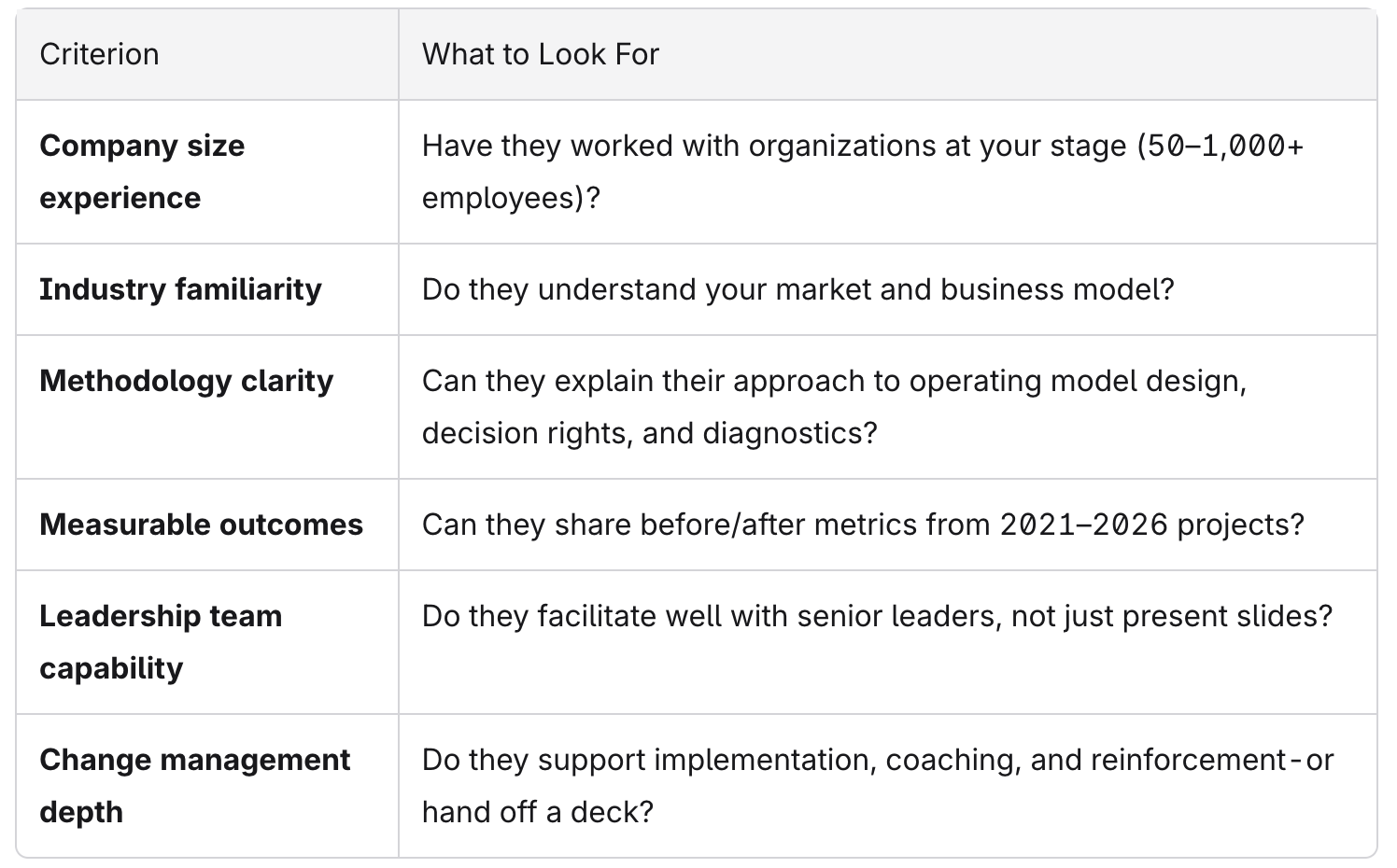
Ask for specific examples: decision speed improved from days to hours, percentage of projects escalated to the CEO dropped, cost savings in overhead, revenue uplift per FTE.
Beware consultants who deliver static future-state charts without implementation support.
A good first move is a pilot diagnostic or design workshop-short, limited in scope-to test chemistry before committing to a multi-month engagement. McKinsey's research on organizational performance reinforces that the method matters as much as the intent.
How Masterly Consulting Group Approaches Organizational Design
At Masterly Consulting Group, we focus on the work that matters most when growth creates friction: clarifying roles and decision rights, designing operating models that match strategy, and building accountability frameworks that prevent confusion as companies scale.
Our approach includes:
- Deep discovery interviews with leadership and cross-functional teams to understand real workflows, not just reported ones.
- Data-backed diagnostics on spans, layers, core processes, and decision patterns.
- Leadership alignment sessions that surface misalignment and build consensus on design principles.
- Practical implementation support including governance routines, role charters, and coaching for managers navigating the transition.
We specialize in helping growth-stage companies-typically 50 to 1,000 employees-whose rapid expansion has created unclear roles, duplicated work, or slow decisions. Sustainable growth requires structure that evolves with the business, not structure that was inherited from the last funding round.
Ready to start? Request an organizational design consultation. We begin with a focused 60–90 minute assessment conversation about your situation-no pressure, no generic pitch.

Frequently Asked Questions About Organizational Design Consultants
Here are the questions founders and CEOs most commonly ask when considering organizational design work.
What does an organizational design consultant do? An organizational design consultant diagnoses how your company's structure, roles, decision rights, and processes align with your business strategy. They redesign operating models, clarify accountability, and guide change management so new structures actually work in practice. Only 21% of organizational redesign efforts succeed according to McKinsey-working with an experienced consultant significantly improves those odds.
How long does an organizational design project take? Targeted interventions-like clarifying decision rights for a single function-can take 6–8 weeks. A full operating model redesign for a mid-market company typically runs 12–16 weeks through initial rollout, with reinforcement continuing for 6–18 months.
What size company benefits most? Inflection points hit hardest around 50 employees (first real need for structure), 150 employees (informal coordination breaks down), 500 employees (complexity demands formal governance), and during post-acquisition integration.
How is organizational design different from organizational structure? Organizational structure is the outcome-the chart, reporting lines, and layers. Organizational design is the method: the analytical process of connecting strategy, roles, decision rights, and core processes to create that structure intentionally.
What data does a consultant need to get started? Typically: current org charts, role descriptions, decision logs, strategic plans, and access to leaders for interviews. The more honest the inputs, the better the diagnosis.
Does our leadership team need to be involved throughout? Yes. Leadership involvement is the single strongest predictor of whether a redesign succeeds or fails. Expect active participation in workshops, design reviews, and governance decisions.