Operational Due Diligence: What Leaders Should Examine Before a Major Business Decision
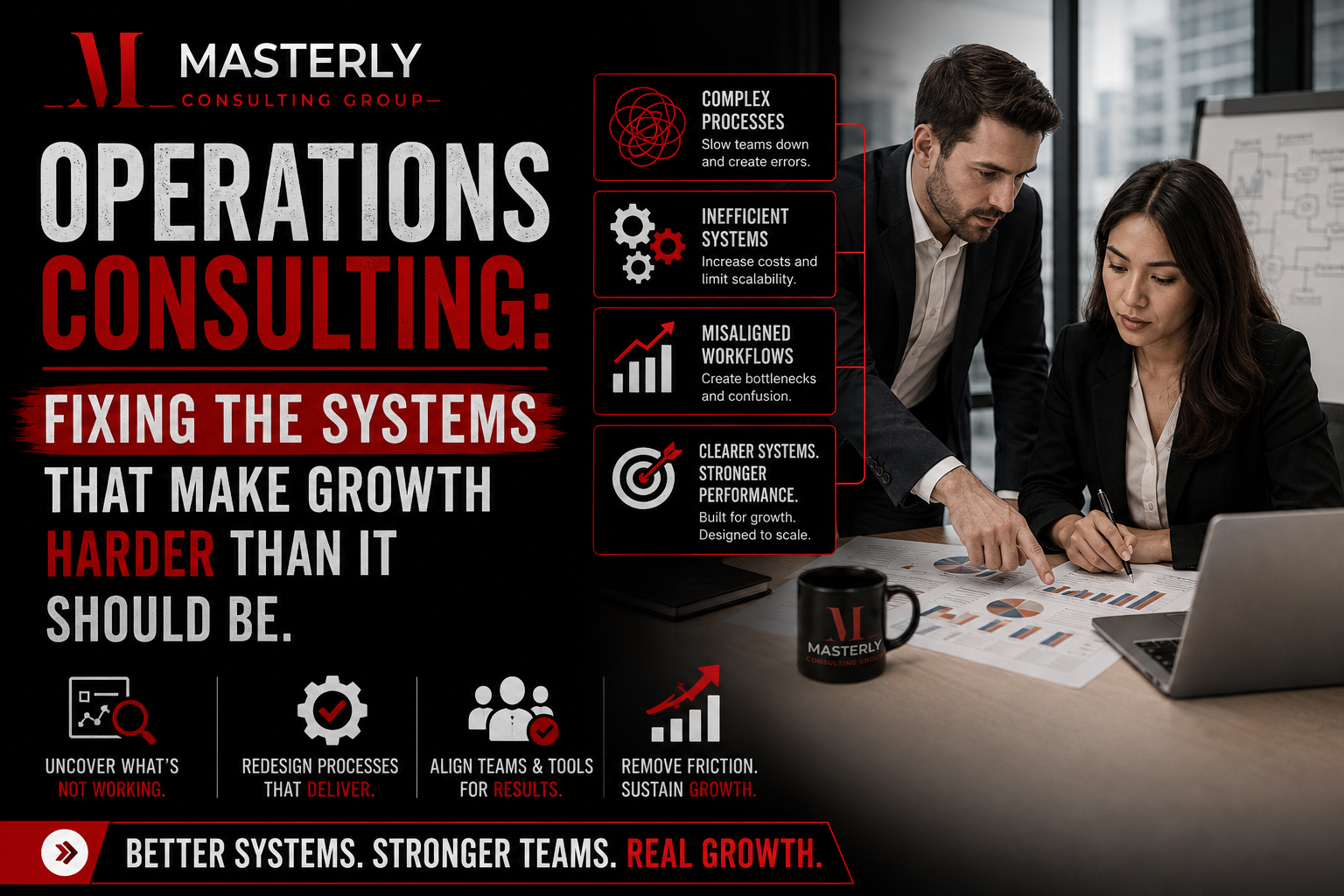
A business opportunity can appear strong in financial reports and still carry serious operating risk. Revenue may depend on a small number of employees. Important processes may exist only in someone’s memory. Technology may be outdated, customer service may be inconsistent, or the company may lack the capacity to support expected growth.
These issues often become visible after an acquisition, partnership, investment, or major change has already been approved.
Operational due diligence helps owners, investors, and executives understand how a business actually works before making a high-stakes decision. It examines the people, processes, systems, capacity, controls, and dependencies behind the reported results.
Masterly Consulting Group provides operations due diligence and operational assessment services for leaders who need a clearer view of execution risk, integration needs, and operating readiness.
Financial Performance Does Not Tell the Whole Story
Financial records show important results, and financial due diligence can test past performance while providing insights into financial stability and growth potential, but they may not explain how those results were produced or how cash flow is sustained.
A company may report strong revenue while depending on one major customer. Profit may be supported by an owner who works far beyond a sustainable level. Service quality may depend on experienced employees who are close to leaving. Growth may have exceeded the capacity of current systems.
The numbers may be accurate while the operation remains fragile.
Operational risks may include:
- Heavy dependence on the founder
- Unclear roles and decision authority
- Processes that are not documented
- Outdated or disconnected technology
- Weak customer handoffs
- Limited management capacity
- High employee turnover
- Unstable supplier relationships
- Poor data quality
- Unresolved compliance concerns
- Capacity limits
- Delayed maintenance or investment
- Inconsistent performance reporting
- Weak internal controls
These concerns can affect valuation, deal terms, integration planning, expected returns, and the time required to improve the business.
Operational due diligence gives leaders more context before they commit resources and helps them assess whether current results can continue in the future despite financial risks under new ownership or changing conditions.
What Operational Due Diligence Should Reveal
A strong review should follow defined focus areas and explain more than whether processes exist. It should show whether the operation can support the proposed business decision.
An acquisition may require the company to integrate with a larger platform. A partnership may depend on reliable service delivery. An investor may expect rapid growth. A restructuring may change responsibilities across several departments.
The review should help leaders understand the operational aspects of the business and how its operational processes perform:
- How work moves through the organization
- Which roles are critical
- Where decisions become delayed
- What systems support delivery
- Where data is stored
- How performance is measured
- What capacity limits exist
- Which controls protect the business
- What must change after the transaction
- How much time and investment improvement may require
The purpose is not to find fault with every process. Every organization has operational gaps. The value comes from identifying which gaps could affect the decision, the transition, or the expected outcome. That focus can also provide input for the value creation plan and help assess potential synergies with the acquiring company.
People and Leadership Dependencies
People are often the greatest operating strength and the largest hidden dependency.
A founder may personally manage major customer relationships, approve spending, solve service problems, and hold knowledge that has never been documented. A senior employee may control a critical system without a trained backup. Managers may have titles but limited decision authority.
These conditions may remain manageable until ownership, leadership, or strategy changes.
Operations due diligence may examine how the management team is structured and supported:
- Leadership responsibilities
- Management depth
- Key-person dependencies
- Role clarity
- Decision authority
- Succession readiness
- Staffing levels
- Employee turnover
- Recruitment challenges
- Training practices
- Performance management
- Contractor reliance
The goal is not to evaluate every employee individually. It is to understand whether the organization has the leadership and workforce capacity to maintain operations and carry out the proposed change.
Leaders should know which employees are essential, what knowledge could be lost, and whether the management team has the capacity to support the business plan during integration.
Process Reliability and Operating Consistency
A company may describe its process differently from how work actually happens.
Written procedures may be outdated. Employees may follow personal methods. Customer requests may move through email, spreadsheets, and informal conversations without clear ownership.
An operational assessment can compare the stated process with actual practice.
Important areas may include:
- Sales-to-service handoffs
- Customer onboarding
- Order or project delivery
- Quality control
- Issue escalation
- Billing and collections
- Vendor management
- Inventory or resource planning
- Customer support
- Approval processes
- Recordkeeping
- Performance reporting
A process does not need to be complex to be reliable. It needs clear ownership, repeatable steps, appropriate controls, and a way to identify failure.
If performance depends on experienced employees correcting problems quietly, leadership may not understand the true cost of the process.
Technology, Systems, and Data Risk
Technology can increase the value of a business or create a large integration burden.
A company may rely on several platforms that do not exchange information. Employees may reenter data manually. Systems may lack documentation, security controls, or reliable support. Critical records may be stored in personal files or spreadsheets.
Due diligence operations should examine how systems and infrastructure support revenue, service, reporting, decision-making, and operational efficiency.
The review may consider:
- Core software platforms
- System ownership
- Integration between tools
- User access and permissions
- Data accuracy
- Reporting reliability
- Backup and recovery
- Vendor contracts
- Licensing costs
- Manual workarounds
- Technology skills
- Planned system replacements
- Cybersecurity responsibilities
- Dependence on custom tools
The purpose is not a complete cybersecurity audit or technical code review unless that work is included in the scope. It is to identify operating concerns that could affect continuity, cost, integration, management visibility, or the protection of sensitive data.
A system may appear inexpensive today but require major investment after a transaction. Leaders need that information before setting integration budgets and timelines. Robust operational infrastructure should also be able to withstand market stress.
Customer and Revenue Concentration
A company’s revenue can look stable while depending on a small number of relationships, services, or employees.
Operational due diligence may examine how revenue is produced and supported, including the business model behind revenue generation and, where needed, the cash flow that supports it. This includes the process behind lead generation, sales, delivery, retention, and customer service.
Questions may involve:
- Revenue concentration by customer
- Dependence on referrals or one sales channel
- Contract renewal patterns
- Customer retention
- Service profitability
- Delivery capacity
- Sales pipeline quality
- Complaint patterns
- Unfulfilled commitments
- Customer ownership
- Cross-selling assumptions
- Pricing practices
This review helps leaders understand whether revenue is supported by a repeatable system or by personal relationships and informal effort.
It can also reveal whether growth assumptions are realistic and whether they fit the company’s business model. A company may be capable of selling more work but unable to deliver it without hiring, process changes, or new systems.
Suppliers, Vendors, and External Dependencies
Operations may depend on suppliers, contractors, landlords, technology vendors, customers, or other outside parties, so customer and supplier relationships need to be reviewed alongside revenue dependence.
A key supplier may have no practical replacement. A vendor agreement may end after a change in control. A contractor may hold critical knowledge without a long-term commitment. Facility or equipment limits may restrict growth.
The review may consider:
- Supplier concentration
- Contract terms
- Service-level expectations
- Pricing changes
- Vendor performance
- Replacement options
- Contractor dependencies
- Facility limits
- Equipment condition
- Insurance responsibilities
- Outsourced operations
- Geographic exposure
These dependencies affect business continuity and integration planning. Leaders should understand which relationships are stable, which must be renegotiated, and which external dependencies, including supply chain exposure, could interrupt operations.
Controls, Compliance, and Escalation
Operational controls and risk management help protect assets, information, customers, employees, and the organization’s reputation.
A company may have policies but lack consistent monitoring. Employees may not know how to report a concern. Leaders may receive information only after the problem has become serious.
An operational assessment may review:
- Approval authority
- Separation of duties
- Expense controls
- Contract approvals
- Information access
- Incident reporting
- Complaint escalation
- Policy ownership
- Training records
- Management review
- Audit findings
- Corrective-action tracking
The U.S. Department of Justice’s guidance on corporate compliance programs asks whether organizations apply risk-based due diligence to acquisitions and integrate acquired businesses into compliance systems after a transaction. DOJ Evaluation of Corporate Compliance Programs
Operational review does not replace legal, financial, tax, cybersecurity, or regulatory due diligence. It helps connect those concerns to the way the organization actually operates and serves as a primary line of defense against operational failure and fraud.
Capacity and Growth Readiness
Growth assumptions should be tested against real operating capacity.
A company may plan to double revenue without understanding whether it has enough managers, employees, equipment, technology, suppliers, or working capital to support that growth.
Capacity review may examine:
- Current workload
- Staffing ratios
- Management span
- Facility and equipment limits
- Delivery lead times
- Backlogs
- Quality problems
- Customer response times
- Training capacity
- Technology limits
- Supplier lead times
- Process bottlenecks
The goal is to determine what the organization can support now and what must change before it can support more.
This information may affect the purchase price, investment plan, hiring schedule, transition timeline, and expected return.
Integration Risk After the Decision
Operational due diligence should look beyond the closing date or approval, because the diligence phase often extends into integration planning and early execution.
Many transactions lose value during integration because leaders underestimate the effort required to combine systems, roles, processes, and cultures.
Integration concerns may include:
- Duplicate leadership roles
- Conflicting policies
- Different operating systems
- Customer communication
- Employee retention
- Process standardization
- Reporting changes
- Technology migration
- Vendor consolidation
- Decision rights
- Brand changes
- Change fatigue
A strong due diligence process identifies these concerns early, can increase the value of a deal, and give a potential buyer a competitive edge in negotiations.
Not every process must be combined immediately. Some systems may need to remain separate during a transition. The important point is to understand which decisions are urgent and which can wait without increasing risk, while informing post acquisition planning and prioritizing the right operational changes.
How Operational Risk Affects Reputation
Operating failures become reputation problems when customers experience missed commitments, inconsistent service, billing errors, or poor communication.
Employees also judge how leadership manages change. A poorly planned integration can create confusion, turnover, and loss of trust. Vendors and partners may become concerned when responsibilities or payment processes change without clear communication.
Operational due diligence helps leaders anticipate where the proposed decision may affect stakeholders. This allows the organization to prepare communication, transition support, and escalation paths before problems reach customers or the public.
The business decision may be confidential, but its operational effects will eventually become visible.
Operational Due Diligence From Masterly Consulting Group
Masterly Consulting Group provides done-for-you operational due diligence for owners, investors, and executives in private equity and sell-side situations, as well as those preparing for acquisitions, partnerships, integrations, investments, or major operational change.
Our services may include this operational due diligence checklist:
- Operational assessments
- Process and workflow review
- Leadership and role analysis
- Key-person dependency review
- Capacity and scalability assessment
- Technology and system review
- Data and reporting assessment
- Customer handoff review
- Vendor and supplier dependency analysis
- Control and escalation review
- Performance-management assessment
- Integration-risk identification
- Operational priority setting
- Leadership findings and recommendations
We define the scope around the decision being considered. An odd checklist can include an initial overview, document review, and onsite assessment, and a good ODD checklist breaks issues into manageable components. This keeps the review focused on the operating factors that could affect value, continuity, implementation, or expected performance.
Our review can also include management interviews and on-site inspections. Our findings are presented in clear business language so leaders can understand the issue, its possible impact, and the decisions it may require.
Masterly Consulting Group works alongside the client’s legal, financial, tax, compliance, and technical advisers when appropriate. Each professional contributes a different part of the full due diligence picture.

Frequently Asked Questions About Operational Due Diligence
What is operational due diligence?
Operational due diligence evaluates the people, processes, systems, capacity, controls, and dependencies behind a business’s performance. It is a structured diligence process focused on the target company and its target company's operations to identify operational risks, constraints, and improvement opportunities before a transaction.
When should operations due diligence occur?
It may be useful before an acquisition, investment, partnership, integration, restructuring, or other major operating decision. In many transactions, the due diligence phase starts before formal signing and can continue beyond the initial review when post-close planning and operational priorities need to be validated.
Is operational due diligence the same as financial due diligence?
No. Financial due diligence focuses on financial information and performance, reviewing past five years information where relevant and providing insights into financial stability and growth potential. Operational review examines how the business produces and supports those results by looking forward.
What does an operational due diligence checklist include?
The scope may include leadership, staffing, workflows, technology, data, vendors, capacity, controls, customers, and integration readiness. Where they affect execution, the review may also assess commercial due diligence findings, market position, the company's business plan, and broader commercial factors.
Can operational due diligence identify hidden costs?
Yes. It may reveal staffing needs, technology replacement, process improvement, deferred investment, vendor risk, or integration work that requires added resources. These findings can also help a potential buyer identify operational improvements that support negotiation and value planning, giving buyers a competitive edge in negotiations. They also show how the company unlocks value through better execution, scalability, and more informed investment priorities.
Does due diligence operations include cybersecurity?
It may identify high-level technology and access concerns, but a specialized cybersecurity assessment may also be required where complex requirements around systems, access controls, and data handling need closer review.
Can Masterly Consulting Group support post-decision integration?
Yes. Qualified engagements may include integration planning, priority setting, governance, accountability, and implementation support.
How long does an operational assessment take?
The timeline depends on the organization’s size, complexity, locations, systems, available records, and the decision deadline.
Does an operational review guarantee that all risks will be found?
No. Due diligence reduces uncertainty but cannot identify every possible issue. In operational due diligence, the review helps protect investors from hidden risks not evident in financial statements, and it also gives institutional investors reputational and fiduciary protection by testing alignment of interests with fund managers. Findings depend on scope, access, records, interviews, available information, and the firm’s professional experience.
Request an Operational Assessment With Masterly Consulting Group
Before an acquisition, partnership, integration, or major change, operational due diligence can help assess whether the target company has the people, processes, systems, and capacity to support the decision while clarifying operational risks before a transaction or investment.
Call Masterly Consulting Group at (972) 236-5051 or visit MasterlyGroup.com to request an operational assessment with Masterly Consulting Group.