Building a University Compliance Training Program That Leaders Will Use
University compliance training must move beyond checkbox courses to provide role-specific decision support tailored for presidents, provosts, deans, coaches, and administrators. When training is structured to translate complex regulations into practical day-to-day actions, documentation protocols, and escalation paths, leaders can apply what they learn with confidence and comply with regulatory requirements effectively.
Immediate Overview: What University Compliance Training Must Deliver for Leaders
This article is designed specifically for higher education leaders, athletics directors, Title IX coordinators, general counsel, and board committees who are evaluating or seeking to improve their current training program. With critical regulatory pressure points emerging between 2024 and 2026—including new Title IX regulations, Gainful Employment and Financial Value Transparency rules effective July 1, 2024, and intensified Clery Act scrutiny following recent campus incidents—now is the time to revisit and strengthen your training design.
Masterly Consulting Group specializes in designing and delivering consultative, scenario-based institutional compliance training tailored for leadership teams, athletics departments, and administrative staff. We don't offer generic e-learning catalogs; instead, we partner with you to build practical, role-focused compliance education that leaders will actually use and that addresses federal funding obligations, ethics, and jurisdictional nuances.
Core Risks That University Compliance Training Must Address
Poor compliance training can lead to serious institutional consequences, including OCR investigations, Department of Education program reviews, accreditation findings, NCAA sanctions, donor distrust, and faculty or staff attrition. Institutions that receive federal financial assistance—and most do through Title IV programs—carry obligations across multiple federal laws and regulations that their employees must understand and comply with.
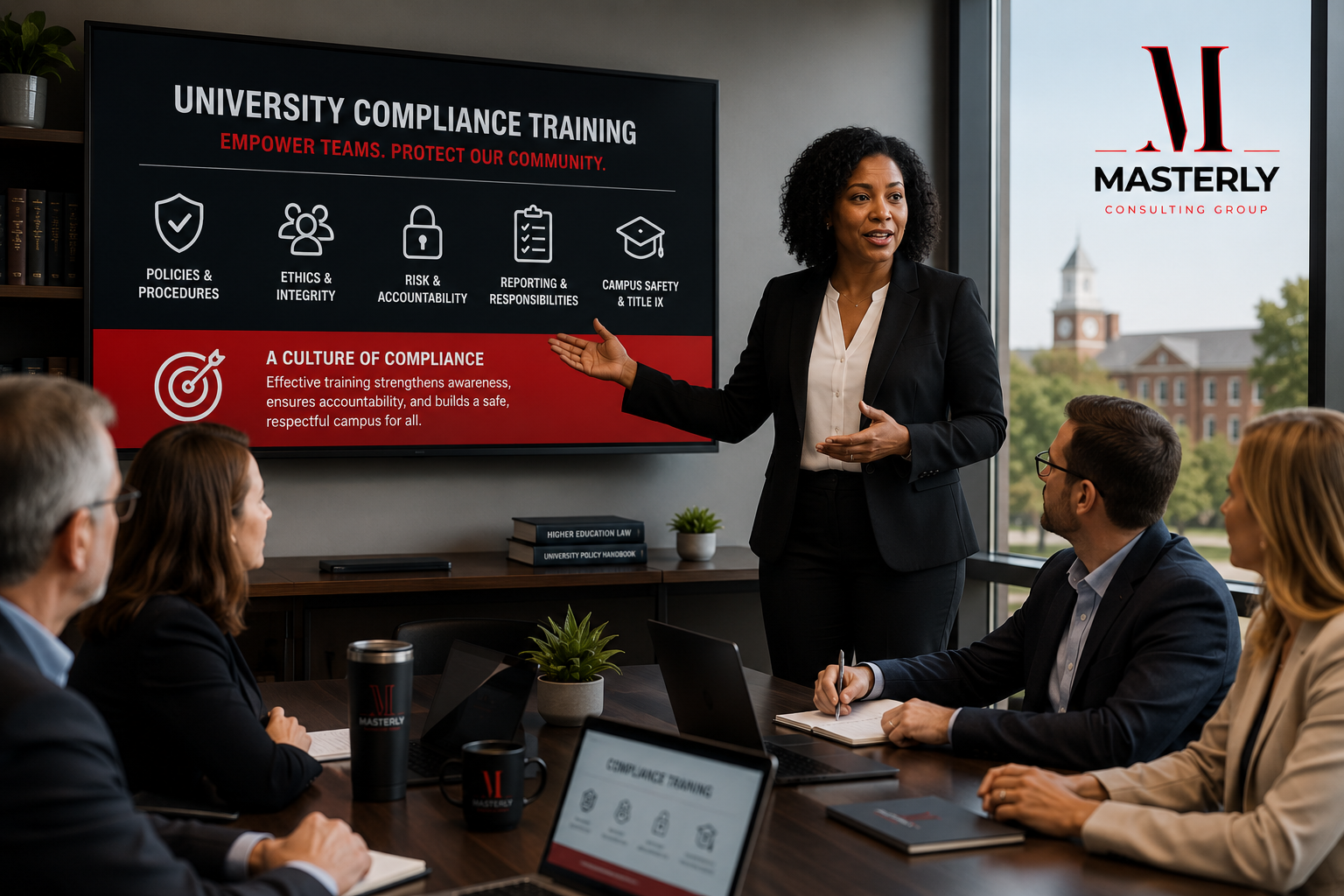
A modern higher education compliance training program must address key risk areas such as Title IX protections, Clery Act crime reporting and emergency notification requirements, financial aid and program integrity rules, research compliance, athletics compliance, data privacy and cybersecurity, employment and HR regulations, and governance responsibilities. It must also cover the Americans with Disabilities Act and other materials relevant to accessibility and inclusion.
Masterly Consulting Group maps these risk domains to specific institutional functions—registrar, housing, athletics, advancement, and campus safety—ensuring training is relevant and actionable rather than generic.
Designing Role-Based Higher Education Compliance Training
Effective compliance training is role-based and layered, not a one-size-fits-all approach. Segmenting training audiences ensures relevance and engagement:
- Executive leadership (president, chancellor, cabinet)
- Deans and department chairs
- Title IX and Clery coordinators
- Athletics leaders and coaches
- Student affairs and housing
- Finance and financial aid
- Research administration
- Board members and trustees
Each audience receives training focused on the concrete decisions they face regularly. For instance, coaches learn how to respond to disclosures during team trips, while deans address conflicts of interest. Managers have a heightened duty to report violations, so their training covers escalation responsibilities beyond general staff needs.
Each module includes a concise legal overview, realistic case studies, visual decision trees or reporting flowcharts, and practical job aids summarizing escalation protocols.
Masterly Consulting Group conducts discovery interviews and document reviews to tailor content precisely to your institution’s risk profile and structure, integrating federal statutes and exceptions that impact compliance.

Title IX and Sexual Misconduct Training for Campus Leaders and Coaches
Title IX training for leaders and athletics staff goes beyond standard modules to cover sexual harassment, assault, dating and domestic violence, discrimination, and retaliation protections. Training clarifies mandatory reporting duties, distinctions between supportive measures and sanctions, coordination among HR, Clery, and Title IX offices, and retaliation risks.
Our training addresses real scenarios such as a student disclosing violence to a coach during travel, detailing required actions within 24 hours, documentation, and support protocols. It also covers the rights of both the accuser and the accused, ensuring fair and impartial processes aligned with statute and regulatory requirements.
Delivered through in-person or live virtual workshops, our sessions use anonymized cases and interactive exercises to build confidence and compliance skills.
Clery Act and Campus Safety: Practical Training for Reporting Duties
Clery Act compliance demands accurate crime statistics, timely warnings, emergency notifications, and transparent policy disclosures. Institutions must distribute their Annual Security and Fire Safety Reports by October 1 each year and maintain accessible crime logs.
Training targets Campus Security Authorities, campus police, housing staff, student conduct personnel, Title IX officers, and others with reporting duties. Content covers Clery crimes, geographic scope, reporting timelines, and distinctions between warnings and notifications.
Masterly Consulting Group integrates Clery training with Title IX and threat assessment to provide unified escalation and documentation processes, preparing leaders to make nuanced safety decisions confidently.
Athletics Compliance and Special Training Needs for Coaches and Directors
Athletics programs face unique compliance challenges including NCAA and conference rules, recruiting, booster relations, NIL activities, and travel oversight. Coaches and directors need concise, role-specific training on recruiting rules, amateurism, academic integrity, financial aid limits, reporting duties, and coordination with compliance offices.
Our micro-session format delivers focused 10–20 minute trainings before, during, and after seasons, featuring real-world scenarios reflecting recent compliance issues. Role-based matrices clarify responsibilities for head coaches, assistants, and operations staff.
Building an Administrator Training Roadmap and Calendar
Sustained compliance requires a planned 12–18 month training cycle aligned with regulations, board schedules, accreditation visits, and athletic seasons. Masterly Consulting Group helps you develop a comprehensive roadmap with annual mandatory modules, role-specific deep dives, and just-in-time refreshers timed to regulatory deadlines and institutional events.
We also incorporate resources for enrollment-facing staff, such as NACAC compliance training for admissions professionals, to ensure broad institutional coverage.
Delivery Models: Blending Workshops, Online Modules, and Scenario Simulations
Our training blends live workshops for nuanced discussion with self-paced online modules for consistency and tracking, plus facilitated tabletop exercises for crisis scenarios. This multi-modal approach ensures effective learning and retention.
We support LMS integration, ADA-compliant formats, and provide dashboards for leadership to monitor completion and impact.
Avoid generic checkbox training. Masterly Consulting Group’s scenario-driven, role-focused sessions prepare your leaders to make confident, compliant decisions.

Measuring Impact: From Attendance Records to Behavioral Change
Boards and presidents expect evidence that compliance training reduces risk and drives accountability. We help you measure impact through completion rates, knowledge assessments, workshop attendance, improved incident reporting quality, increased use of anonymous channels, fewer repeat errors, and stronger accreditation outcomes.
Our training impact dashboards and follow-up interviews provide leadership with clear insights into behavioral changes and program effectiveness on an annual basis.
Partnering With Masterly Consulting Group: Next Steps and Call to Action
Masterly Consulting Group partners with universities, colleges, and community colleges to design tailored training, lead leadership and board workshops, deliver athletics compliance sessions, and integrate with existing compliance systems. Our consultative, scenario-based approach ensures your training is practical, relevant, and supports long-term institutional resilience.
Our engagement process includes:
- Scheduling a no-obligation institutional training needs assessment
- Receiving a gap analysis and prioritized roadmap
- Piloting high-impact workshops (e.g., Title IX and Clery for leaders, athletics compliance for coaches)
- Scaling to a full training program over the academic year
Prepare for your assessment by gathering recent policy updates, incident trends, and training completion reports to enable a data-informed conversation.
Schedule your institutional training needs assessment today by calling (972) 236-5051 or visiting https://www.masterlygroup.com/. Investing in structured, role-based university compliance training builds safer, more trustworthy campuses where students, faculty, and staff can thrive.
Take the next step toward compliance excellence—contact Masterly Consulting Group now to customize a training program that fits your institution’s unique needs and ensures confident, responsible leadership across all campus roles.